

Book Your Appointment Today!
Our staff will reach out to you shortly
Thank you! Your submission has been received!
Oops! Something went wrong while submitting the form.


Think of a professional dental cleaning in Houston as a vital tune-up for your smile. Your daily brushing and flossing are like keeping your car topped up with gas and washing the windows—essential, but they don't cover everything. A professional cleaning is that expert deep-dive service that gets into the nooks and crannies you simply can’t reach on your own.
It's the kind of care that truly resets your oral health and gives you a fresh start.
Understanding the process of a dental cleaning can help reduce anxiety and empower you to take an active role in your oral health. Let’s walk through the entire process, so you know exactly what to expect and how this straightforward visit protects not just your smile, but your overall wellness.
Here's a quick look at the main stages you'll go through during your appointment.
This table breaks down each step of the process, explaining what your hygienist is doing and, more importantly, why it's a necessary part of your preventive care.
Each step builds on the last, leaving you with a healthier, cleaner smile than when you walked in. Now, let’s look at those steps a little closer.
Before any cleaning begins, your dental hygienist will conduct a thorough visual check of your mouth. Using a small mirror, they'll inspect each tooth and your gums for any red flags—such as inflammation (gingivitis), deep pockets, or cavities. This isn't just a formality; it allows them to tailor the cleaning specifically to your oral health condition.
Now for the main event: scaling. The sticky film of bacteria that constantly forms on your teeth is plaque. If it isn't removed daily, it hardens into tartar (also called calculus), and once that happens, no amount of brushing at home can get it off.
Your hygienist uses a special instrument called a scaler to gently scrape that tartar away from your gum line and from between your teeth. This step is a critical action for preventing gum disease from starting or progressing. To see how this fits into our broader approach, you can learn more about our dental hygiene services in Humble, TX.
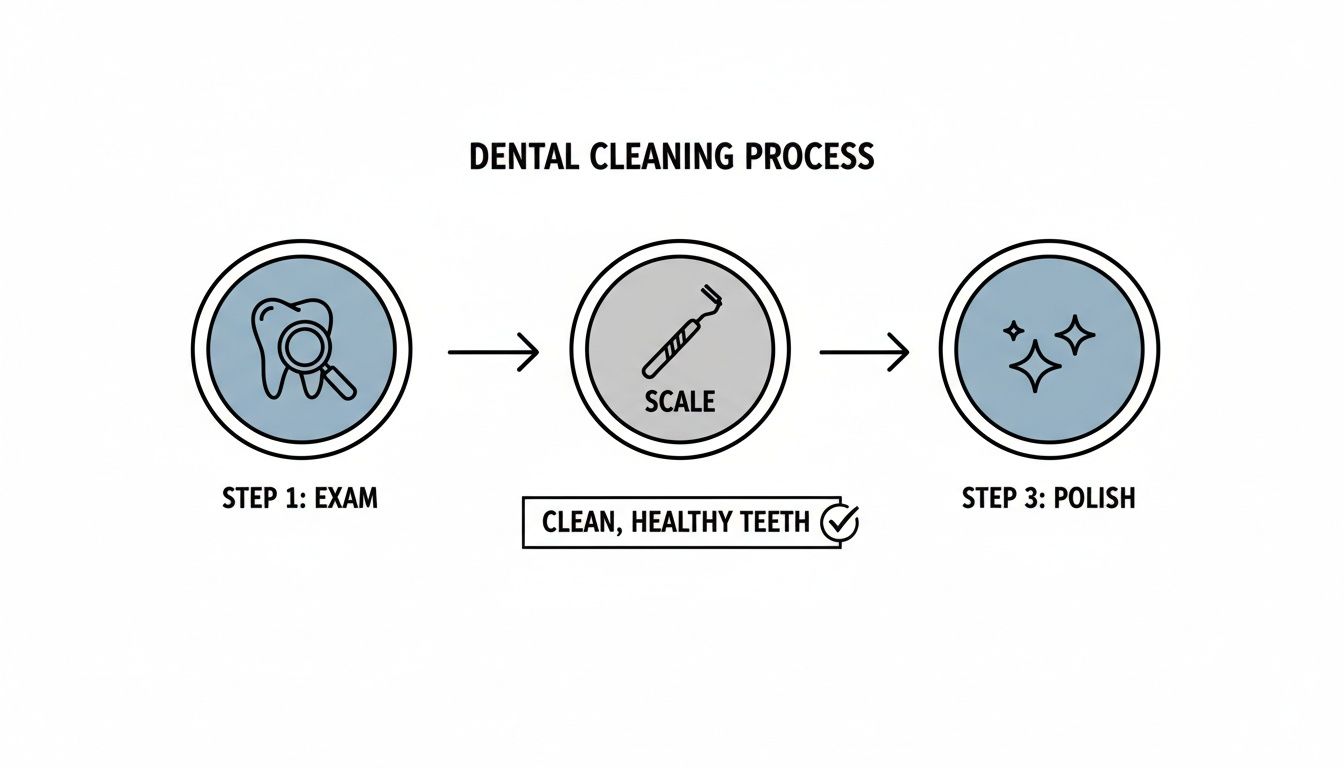
As you can see, the process is a logical flow, moving from the initial check-up to the deep cleaning and finally to the finishing touches that make your smile shine.
Once the tartar is gone, your hygienist will use a high-powered electric brush and a gritty, professional-grade toothpaste to polish your teeth. This action buffs away any remaining surface stains and leaves your teeth feeling incredibly smooth and looking brighter.
A professional polish isn't just for aesthetics. It creates a smoother tooth surface, making it much harder for new plaque to adhere.
To finish, your hygienist will floss between your teeth with an expert touch, reaching deep into spots you might miss to remove any lingering plaque or paste. A quick rinse washes everything away, and often, a fluoride treatment is applied. This acts as a protective topcoat for your teeth, helping them resist cavities for the next several months.
When you schedule a dental cleaning in Houston, it's important to know it’s not a one-size-fits-all procedure. Your dentist will recommend a specific type of cleaning based on your current oral health. Think of it like car maintenance: a new vehicle may only need a basic oil change, while an older one might require a more comprehensive tune-up.
Knowing the difference between these cleanings helps you understand your treatment plan and make informed decisions about your care. Each one serves a specific purpose, from routine prevention to active management of gum disease.

This is the cleaning most people are familiar with—what you’d consider a "regular" check-up. A prophylaxis cleaning, or "prophy," is designed for patients with generally healthy gums and minimal tartar buildup. Its primary goal is preventive maintenance. During a prophy, your hygienist removes the soft plaque and hard tartar that have accumulated above your gumline. This routine visit is essential for maintaining healthy teeth and gums and stopping gum disease before it can start.
If your dentist detects signs of active gum disease, like gingivitis or periodontitis, they will recommend scaling and root planing. Often called a "deep cleaning," this procedure is more thorough than a standard prophy and serves as the first line of defense to halt the progression of gum disease.
Here’s a breakdown of the two-part process:
Think of a deep cleaning as a therapeutic reset for your gums. It removes the source of the infection and provides a clean slate for healing, protecting you from more severe problems like bone and tooth loss.
After a deep cleaning, your oral hygiene strategy changes. You will move from standard prophy cleanings to periodontal maintenance visits. These appointments are scheduled more frequently, typically every three to four months. The objective is to protect the progress achieved with the deep cleaning. Your hygienist will focus on cleaning below the gumline in any remaining pockets, preventing bacteria from recolonizing and reactivating the disease. This ongoing care is the key to managing periodontal disease long-term.
In cases where a significant amount of tartar has built up, it can obscure the teeth and prevent the dentist from performing a thorough examination. In these situations, a gross debridement is the necessary first step. This procedure removes the bulk of the heavy tartar buildup. It's important to understand this is not a "complete" cleaning but a preparatory step. It clears the way for a comprehensive exam, after which your dentist can accurately determine whether a standard prophy or a deep cleaning is the next appropriate treatment.
Viewing a dental cleaning as merely a way to brighten your smile is an understatement. The most important work happens beneath the surface. A professional cleaning is a cornerstone of your total wellness strategy, with benefits that extend far beyond your mouth.

While preventing cavities, lifting stains, and achieving fresh breath are immediate benefits, the real power of a cleaning lies in its ability to prevent gum disease, a leading cause of tooth loss in adults. This is where the connection to your overall health becomes critically important.
Your mouth is a gateway to the rest of your body. When harmful bacteria accumulate along your gumline, they can trigger inflammation and enter your bloodstream, traveling to other organs and contributing to serious health conditions. This connection is a well-established medical fact, making oral healthcare a proactive step in protecting your entire body.
Here are a few of the most critical systemic links:
"A professional dental cleaning isn't just about preserving your teeth; it's about safeguarding your systemic health. By managing oral bacteria, we are actively reducing inflammatory triggers that can impact your heart, blood sugar, and more."
For busy Houstonians, it's easy for preventive care to fall down the priority list. However, scheduling a regular dental cleaning in Houston is one of the wisest investments in your long-term health. As the city grows and demand for quality dental care increases, maintaining consistent appointments is more crucial than ever.
Heading into 2026, dental professional shortages continue to affect major cities, including Houston. The Health Resources and Services Administration has identified thousands of shortage areas, with Texas alone having 275. This data underscores the importance for Houston-area families to establish a relationship with a trusted local practice. For more insights, you can read about how dental shortages are being addressed on BeckersDental.com.
Ultimately, scheduling a cleaning is not a chore to be postponed. It is a non-negotiable step toward protecting your smile and supporting your overall vitality.
Understanding the cost of a dental cleaning in Houston is a primary concern for many. The good news is that routine cleanings are one of the most affordable forms of dental care you can receive.
The final cost depends on your specific needs. A standard preventive cleaning will have a different price than a more involved deep cleaning for gum disease. For a routine adult cleaning in the Houston area without insurance, you can typically expect prices to range from $75 to $200. A deep cleaning is a therapeutic treatment and is often priced per quadrant of the mouth.
Most dental insurance plans are structured around the principle of prevention. They encourage routine check-ups and cleanings because addressing minor issues early is far less expensive than treating major problems later. As a result, many plans cover preventive care, like cleanings, at a high percentage, often 100%.
This coverage typically includes:
For many insured families in Houston, this means regular cleanings have little to no out-of-pocket cost, making it one of the most effective ways to maximize your benefits and maintain oral health.
Concerns about cost should never stand between you and a healthy smile. There are more flexible and affordable paths to getting the care you need than you might think.
If you don't have dental insurance, you still have excellent options. Many dental practices offer solutions to make care more accessible. An in-house savings plan is a popular choice, acting like a membership program. You pay a flat annual fee directly to the dental office, which covers your preventive care—cleanings, exams, and necessary X-rays—at no additional cost. These plans also typically provide discounts on other treatments, offering a straightforward way to budget for dental health without dealing with deductibles or annual maximums. Learning about how these plans create a path for affordable dental care in Houston can help you decide if it’s a good fit.
Third-party financing through companies like CareCredit or Cherry is another practical route. They specialize in breaking down healthcare costs into manageable monthly payments, often with low- or no-interest promotional periods.
To clarify your options, here is a comparison of common payment methods. This table provides a quick overview to help you find the best fit for your budget.
The goal is to find a payment solution that removes financial stress so you can focus on what matters most: maintaining a healthy, bright smile.
Choosing a dentist is about more than proximity; it's about finding a long-term healthcare partner you trust. A great dentist makes you feel heard, comfortable, and confident in your care, transforming a routine necessity into a positive experience.

In a large city like Houston, this selection process is especially important. With numerous options and growing demand, finding a practice that is accepting new patients and is a good fit for your family is key to receiving consistent, high-quality treatment.
When searching for a new dental home, certain factors can make a significant difference. For example, a practice that invests in modern technology like digital X-rays (which reduce radiation exposure) or AI-powered diagnostic tools can offer more accurate and comfortable treatments.
Consider these actionable points when evaluating a dental practice:
A truly great dental practice doesn’t just treat teeth; it treats people. The right team will make you feel like family, building a relationship based on trust and a genuine commitment to your well-being.
External factors, such as workforce shortages, can impact your access to care in a major market like Houston. Texas is currently facing a significant shortage of dental hygienists, the professionals who perform most routine cleanings. Projections indicate a supply-demand gap of over 2,700 full-time hygienists by 2036.
This shortage can lead to longer wait times for essential preventive appointments, making it crucial to find a reliable practice. You can see the full projections and understand the oral health workforce in Texas on DSHS.Texas.gov. A practice with a stable, dedicated team is often a sign of a healthy work environment and a commitment to consistent patient care. For a deeper dive, review our guide on how to choose a good dentist for your needs. Taking the time to research these qualities will help you find a trusted partner for your family's oral health.
Even after reviewing the process, it's normal to have a few more questions. When it comes to a dental cleaning in Houston, clear information helps everyone feel more relaxed and confident about their care. Here are straightforward answers to some of the most common questions we hear.
For most people, a routine dental cleaning is a painless experience. You will likely feel light pressure, scraping sensations, and the vibration of the polishing tool, but it is designed to be gentle. If you have sensitive teeth, inflamed gums (gingivitis), or significant tartar buildup, you may experience some minor discomfort. Actionable Tip: Always communicate with your hygienist. If you feel any discomfort, let them know. They can apply a topical numbing gel or adjust their technique to ensure you remain comfortable.
The standard recommendation for most adults with healthy teeth and gums is a professional cleaning every six months. This twice-a-year schedule is ideal for controlling plaque and tartar and allows your dental team to detect potential issues early. However, this is not a universal rule.
Your dentist may recommend more frequent cleanings (every three to four months) if you:
This personalized schedule is designed to keep your mouth in optimal health.
Think of at-home care and professional cleanings as a team. Your daily brushing and flossing are for daily maintenance—they remove fresh plaque, food particles, and bacteria. This is your essential first line of defense. A professional cleaning is the deep-clean service that addresses what you can't. Once plaque hardens into tartar (calculus), it can only be removed with specialized dental instruments.
Your hygienist uses specialized tools to meticulously chip away this hardened tartar, especially from tricky spots your brush can't reach, like just below the gumline. A professional cleaning basically hits the reset button on your oral health in a way daily brushing just can't.
Maintaining that fresh-from-the-dentist feeling is achievable with consistent habits. Actionable Tip: Brush your teeth for a full two minutes, twice a day, and floss at least once daily. To enhance your routine, consider adding an antiseptic mouthwash to reduce bacteria. Additionally, limiting sugary foods and drinks helps starve the bacteria responsible for plaque and cavities. These simple actions make a significant difference and contribute to a smoother cleaning at your next appointment.
The dental hygienists who perform these vital cleanings are in high demand, especially in a growing city like Houston. Local institutions like UTHealth Houston School of Dentistry are crucial for training the next generation. For its Dental Hygiene Class of 2026, the school welcomed 34 students from nearly 100 applicants, highlighting the high standards and demand for these roles. This pipeline ensures Houston families continue to have access to top-notch preventive care. You can find more details about UTHealth's incoming class and its impact on Houston's dental workforce.
Ready to experience modern, compassionate dental care for your family? At Clayton Dental Studio, we combine advanced technology with a patient-first approach to ensure every visit is comfortable and effective. From routine cleanings to same-day crowns and cosmetic treatments, we offer everything your smile needs under one roof. We’re proud to serve the Humble, Atascocita, and greater Houston communities. Schedule your appointment today and discover the difference a dedicated dental team can make. Visit us online at https://www.claytondentalstudio.com.