

Book Your Appointment Today!
Our staff will reach out to you shortly
Thank you! Your submission has been received!
Oops! Something went wrong while submitting the form.


Choosing a good dentist is a critical decision for your long-term health, and it requires more than a quick online search. Finding the right dental partner involves practical research before you ever make a call. By following a clear process—verifying credentials, analyzing patient reviews, and evaluating a clinic's services—you can create a shortlist of qualified candidates and select the best fit for your needs.
Before booking consultations, the first step is to conduct initial research to identify promising options. This preliminary screening helps eliminate practices that don't align with your needs, saving you time and effort. The objective is to find a dentist who not only provides routine cleanings but also meets specific requirements, whether it's pediatric care for your family or complex restorative procedures for yourself.
Online reviews are a useful starting point, but a simple star rating lacks context. To gain real insight, read the comments to understand the actual patient experience. Your goal is to identify consistent patterns.
A recurring theme in reviews is far more informative than an isolated five-star or one-star comment. If multiple patients report long wait times, billing errors, or feeling rushed by the dentist, consider these significant red flags. Conversely, consistent praise for a gentle hygienist or an efficient front desk staff is a strong positive indicator.
Focus your analysis on these specific details:
This methodical approach provides a clear understanding of the clinic’s operational culture, offering a more accurate picture than a star rating alone.
Once you have a few candidates, verify their qualifications to ensure they meet professional standards. This is a non-negotiable step in choosing a good dentist.
Use your state’s dental board website to confirm that the dentist is licensed and to check for any disciplinary actions. Additionally, look for memberships in professional organizations like the American Dental Association (ADA) or the Academy of General Dentistry (AGD). These affiliations signal a commitment to continuing education and adherence to high ethical standards.
It is also crucial to confirm their services match your needs. If you require care for your entire family, our guide on finding the right family dentist in Houston provides a checklist of what to look for.
With a shortlist created, your focus should shift from clinic logistics to the dentist's professional competence and communication style. While a modern office is a plus, the most critical factor for long-term patient satisfaction is the dentist's technical skill and the trust you build with them.
A top-tier dentist combines clinical expertise with effective communication. They should make you feel confident in their abilities and respected as a partner in your health decisions. This step is about evaluating that balance.
A dentist’s communication style is a direct reflection of their patient care philosophy. A great dentist acts as both a provider and an educator, breaking down complex dental issues into understandable terms. They should ensure you comprehend your oral health status and the reasoning behind any recommended treatment.
During your consultation, observe their behavior. Do they maintain eye contact and listen to your concerns without interruption? Or do they seem rushed and distracted? The time they dedicate to answering your questions is a key indicator of their approach.
A patient-focused dentist ensures you feel like the priority. Your comfort and understanding should always take precedence over their schedule.
Treat your first consultation as an interview. You are hiring a professional for a critical role. Preparing specific, insightful questions will reveal far more about their approach than a standard examination.
Here are a few targeted questions to guide your conversation:
A trusting relationship is built on clear communication. To help you prepare, review our guide on the top questions to ask your dentist before your visit.
The link between a dentist's performance and patient satisfaction is well-documented. A 2022 analysis found that a dentist's ability to explain procedures, listen effectively, and show respect was the single largest predictor of patient satisfaction, accounting for 42.6% of the variance in ratings. You can learn more about these patient satisfaction findings to understand what truly matters.
Dental offices vary significantly in their environment and service model. Understanding these differences is a critical part of choosing a good dentist. The primary distinction is often between a private practice and a public dental clinic.
Consider your priorities. Do you prefer a personalized setting with consistent one-on-one attention, or is your main goal to receive efficient, affordable care? Neither model is inherently better; the right choice depends on your specific needs and comfort level.
A private dental office typically offers a more personalized experience, allowing you to build a long-term relationship with a consistent care team. You often see the same dentist and hygienist at each visit, which enhances continuity of care. These practices also tend to adopt the latest technology and provide a broader range of cosmetic and specialized services.
In contrast, public health clinics prioritize accessibility and affordability. They are a valuable resource for routine care or urgent dental issues, particularly for patients with budget constraints. The experience may be less personal, as you might see different providers, and wait times can be longer.
Research confirms a measurable difference in patient satisfaction between these models. One study found that private clinics consistently received higher scores across all service areas, from clinical performance to administrative support. This is often attributed to greater one-on-one attention and ongoing staff training.
To help you make an informed decision, here is a breakdown of the key differences.
Ultimately, the best choice depends on your priorities. If you require specialized work and value a consistent relationship with your provider, a private clinic is likely the better fit. If affordable access to essential care is your primary concern, a public clinic is an excellent resource.
Use your specific circumstances as your guide. A family with young children should seek a practice with pediatric experience and flexible scheduling. If you are considering cosmetic enhancements, you need a dentist with a proven specialization in that area and a portfolio of results.
This diagram highlights the core drivers of patient satisfaction, regardless of clinic type.
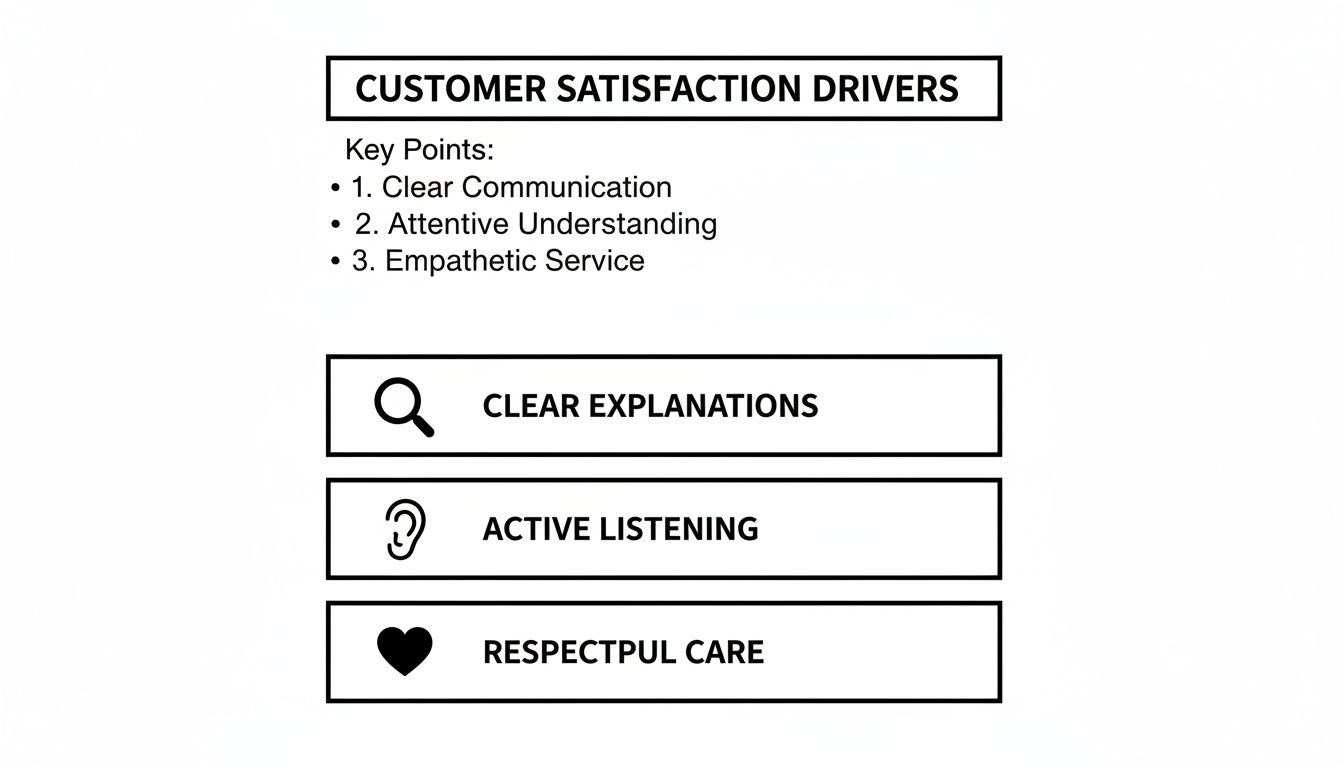
Feeling heard, understood, and respected is what transforms a dental appointment into a positive healthcare experience.
Actionable Insight: Choose a dentist by aligning their service model with your practical needs. Look beyond the list of services to consider how they are delivered and whether the environment makes you feel comfortable and valued.
Data shows that demographic factors can influence satisfaction. For example, some research indicates that women and younger patients report 10-15% higher satisfaction levels. While the dentist's skill remains the most important factor, the clinic environment itself accounts for 31.5% of the variance in patient satisfaction. It is a significant component of your overall experience.
Identifying a skilled dentist with a positive patient approach is essential, but practical logistics can determine the long-term success of the relationship. A dentist is not a good fit if their office policies are incompatible with your life. This final step involves confirming insurance, payment options, and scheduling to ensure a smooth partnership.
Clarifying these details before committing to a practice prevents future administrative and financial issues. This is a crucial step in choosing a dentist who works for you in every respect.
Before proceeding, your first logistical task is to verify insurance. Do not rely solely on your insurance provider's online directory, as these can be outdated. The most reliable method is to call the dental office directly.
When you call, have your insurance information ready and ask these direct questions:
Pay attention to how the staff responds. Clear, confident, and helpful answers indicate they are experienced in navigating insurance and are committed to helping you maximize your benefits.
Even with insurance, out-of-pocket costs are common. A well-managed practice understands this and offers flexible solutions to make dental care more affordable. Always ask about payment options beyond immediate full payment.
Many offices provide payment plans or partner with third-party financing companies. These arrangements can distribute the cost of a significant procedure, like a crown or implant, into manageable monthly installments.
For patients without insurance, inquire about in-house membership plans. With these plans, you pay an annual fee for included preventive care and receive substantial discounts on other treatments. Understanding your options for dental in-house financing can make essential care accessible.
Finally, evaluate day-to-day convenience. An office that fits your schedule is one you are more likely to visit for regular checkups.
Confirm these practical details:

Sometimes, the most effective way to find the right dentist is by knowing how to identify the wrong one. This final check helps you avoid practices that could lead to future problems. While some red flags are obvious, others are more subtle. Always trust your intuition; if something feels wrong during your initial interactions, it likely is.
Your dental care should not feel like a sales presentation. A significant red flag is a practice that pressures you into expensive cosmetic procedures before addressing your fundamental oral health. While discussing options like teeth whitening or veneers is appropriate, it should never be a high-pressure sales tactic. The primary focus must be on the health of your teeth and gums.
A great dentist prioritizes your oral health foundation—treating cavities, gum disease, or pain—before suggesting a complete smile makeover. Their recommendations should be presented as a collaborative health plan, not a sales target.
Be cautious of language that creates a false sense of urgency or dismisses more conservative and affordable treatment options. Your care plan should be a dialogue, not a directive.
Clear communication is non-negotiable. You must feel comfortable asking any question and receiving a direct, transparent answer, especially regarding critical topics like sterilization protocols and billing. If you inquire about instrument sterilization and receive a vague or defensive response, that is a serious warning sign. A quality practice will be proud to explain its hygiene procedures.
Watch for these other communication failures:
Ultimately, choosing a good dentist requires finding a professional and a team you can trust. By being vigilant for these red flags, you can filter out unsuitable candidates and select a practice that is genuinely committed to your well-being.
Choosing a new dentist is a significant decision, and it is common to have questions. Getting clear answers will help you move forward with confidence. Here are some of the most frequently asked questions.
Online reviews are a valuable tool for assessing a practice's reputation, but they should be analyzed critically. The key is to look for consistent patterns rather than focusing on isolated comments.
If you see numerous reviews praising a gentle hygienist or an efficient front office, that is a strong positive signal. Conversely, if multiple patients mention feeling rushed or encountering billing problems, that pattern is a red flag. A single negative review may be an anomaly, but consistent feedback is usually a reliable indicator of the patient experience.
This is a common question with a simple answer: there is no clinical difference.
Both DDS (Doctor of Dental Surgery) and DMD (Doctor of Dental Medicine) indicate that a dentist has graduated from an accredited dental school and passed the same national and state licensing examinations. The specific title depends on the university that awarded the degree. You can be confident that a dentist with either degree is fully qualified to provide high-quality care.
Yes, this is a highly recommended step. A meet-and-greet consultation is a low-pressure opportunity to evaluate the office environment and interact with the team before committing to treatment.
This initial visit is your chance to assess the clinic's atmosphere. You can see the facility, meet the staff, and ask the dentist any remaining questions. Does their communication style align with your preferences? Do you feel comfortable and respected?
Many dentists offer these introductory consultations for free or for a nominal fee. It is a small investment of time that can prevent future dissatisfaction by ensuring you have found a team you trust for your long-term care.
Finding the right dentist is about more than just qualifications; it's about finding a team that makes you feel like family. At Clayton Dental Studio, we combine advanced technology with a compassionate, patient-first approach to help you and your loved ones achieve healthy, confident smiles. Schedule your visit with us today!