

Book Your Appointment Today!
Our staff will reach out to you shortly
Thank you! Your submission has been received!
Oops! Something went wrong while submitting the form.


When you think about a healthy smile, pearly white teeth usually steal the show. But the true foundation of your oral health is your gums. To know if your gums are healthy, check for three key signs: a consistent coral pink color, a firm texture, and most importantly, they should never bleed when you brush or floss. If you can check off all three, you're on the right track.
It’s easy to focus on teeth, but your gums are the unsung heroes of your mouth. They do more than just frame your smile; they form a critical barrier, protecting the roots of your teeth and your jawbone from harmful bacteria. When that barrier is compromised, the consequences can extend far beyond your mouth.
Learning to spot the signs of healthy (and unhealthy) gums is a game-changer because their condition directly reflects what's happening in the rest of your body. Researchers have uncovered serious connections between gum disease and other major health issues, making gum health a critical component of your overall well-being.
Think of your gums as the gatekeepers to your bloodstream. If they become inflamed or infected—a condition known as gum disease—that protective seal is broken. Bacteria from your mouth can slip into your circulatory system and travel throughout your body. This has been linked to a host of significant health problems.
When you look at it that way, a quick, one-minute gum check every day is one of the most powerful preventative habits you can adopt. It’s a real-time status update on not just your mouth, but your whole body.
This isn't a rare problem. Gum disease is incredibly common. In fact, it's one of the most widespread oral health conditions, affecting roughly 47% of adults over 30. That number jumps to a staggering 70% for seniors. You can discover more insights about these oral health statistics to see just how significant this challenge is.
This guide provides the practical knowledge you need to check your own gums, understand what you’re looking for, and take the right steps to protect your smile—and your health—for the long haul.
You don't need a special appointment to monitor your gum health. The best time to do a quick check is during your daily brushing and flossing routine. A good look in the mirror is all it takes to start understanding the signals your body sends. Catching these signs early is the key to preventing minor issues from turning into major problems.
The first thing to assess is color. Healthy gum tissue typically has a consistent coral-pink shade. Everyone is different—your natural pigmentation might mean your gums are slightly darker or have spots, which is perfectly fine. The key here is consistency. You’re looking for a uniform color, not patches of red, unusual paleness, or other discolorations. Those are often the first signs of inflammation.

Next up is texture. Gently press on your gums with a clean finger. They should feel firm and resilient, not puffy, tender, or soft. A good comparison is the texture of an orange peel—it has that sturdy, stippled feel. Healthy gums bounce back; unhealthy gums might feel squishy or even hurt when you press them.
Finally, examine the shape. Healthy gums create a clean, scalloped line that hugs each tooth snugly. This tight seal is your mouth’s first line of defense, keeping bacteria and food debris from getting under the gumline where trouble starts. If you see gums that look swollen or are losing that crisp, curved shape, it’s a red flag for inflammation.
To make it even easier, here's a quick comparison table you can use during your self-check.
Use this quick comparison table during your self-check to instantly spot the key differences between healthy gum tissue and potential warning signs.
Looking at these side-by-side clarifies what you should be monitoring. A quick glance at this chart can make your daily check-in fast and effective.
Here is a critical fact: a little bleeding is not normal. It’s one of the most common myths in oral health. Your gums are designed to be tough and should easily withstand gentle brushing and flossing without bleeding.
Think of bleeding as your body’s fire alarm. It signals that plaque and bacteria are building up, irritating the tissue, and causing inflammation. This is the very first stage of gum disease, called gingivitis.
Even a tiny bit of pink in the sink is a sign that you need to be more diligent with your oral hygiene. Don't ignore it. By paying attention to these simple visual and tactile cues, you're taking control of your health—and that's the foundation for a great smile.
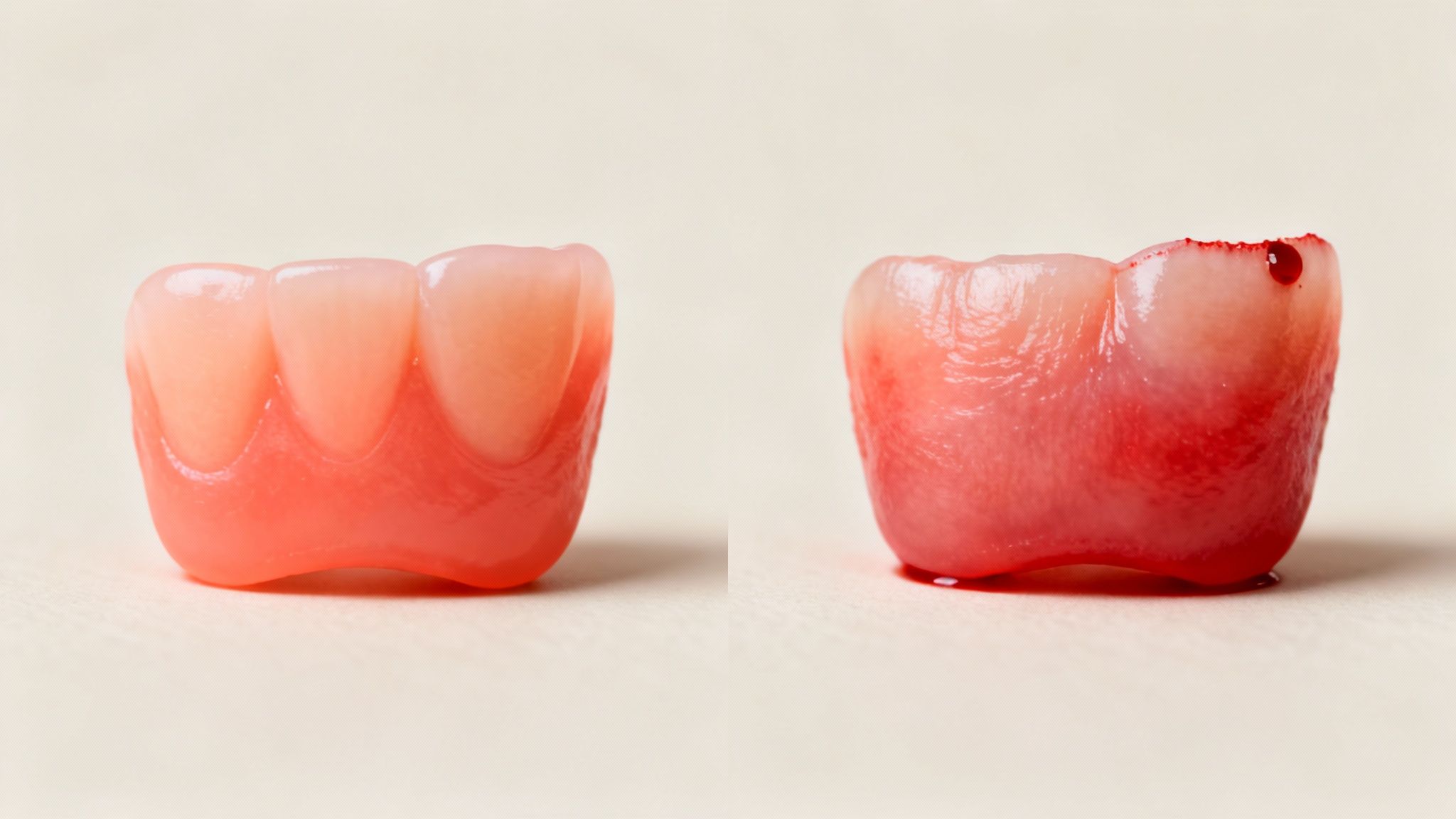
While that perfect coral pink is the goal, unhealthy gums can appear in a range of troubling colors. Think of each shade as a signal your body is sending, pointing to an issue that needs attention. When we ignore these changes, we’re often overlooking the first stages of gum disease.
An angry, bright red or even purplish color is the classic sign of gingivitis, the earliest form of gum disease. That color change is pure inflammation—it’s your body rushing more blood to the area to fight off bacteria that have built up along your gumline. On the other hand, gums that look unusually pale or white might hint at other health issues. Any major shift from your normal, healthy pink is your cue to start paying closer attention.
One of the most common—and most frequently ignored—red flags is bleeding. If you saw blood after washing your hands, you wouldn't just shrug it off. The same logic applies to your mouth. Healthy gums do not bleed from the gentle friction of brushing or flossing. Period.
Seeing pink in the sink is your body’s alarm system blaring. It's a clear indicator of active inflammation from plaque buildup. This is your sign to get more serious about your oral hygiene, because persistent bleeding is the first step on the path from simple gingivitis to more significant gum problems.
Beyond color and bleeding, your gums have other ways of telling you something’s wrong. These signs often appear together and can worsen if unaddressed.
The global impact of these issues is enormous. Oral diseases affect roughly 3.7 billion people, with periodontal disease cases soaring past 1 billion worldwide. The financial toll is just as significant, with indirect costs from lost productivity exceeding $150 billion in the United States alone.
When gum disease progresses from reversible gingivitis to the more serious stage called periodontitis, the damage becomes structural and permanent. Receding gums are a major warning sign that this is happening. When you notice your gums pulling away, making your teeth look longer, it’s because the underlying bone and tissue are being destroyed. This process is irreversible and creates even larger pockets for infection.
Eventually, this bone loss can cause teeth to feel loose or shift out of place. This is a very late-stage symptom, meaning significant damage has already occurred. If you feel any changes in your bite or notice your teeth moving, it’s crucial to get professional help immediately to prevent tooth loss.
Knowing the signs of healthy and unhealthy gums is the first step, but building the right habits makes the real difference. To improve your gum health, you need to move beyond a quick brush and floss. Specific techniques can dramatically improve your gum health and keep inflammation at bay.
The best part? These are simple, effective practices you can start using tonight.
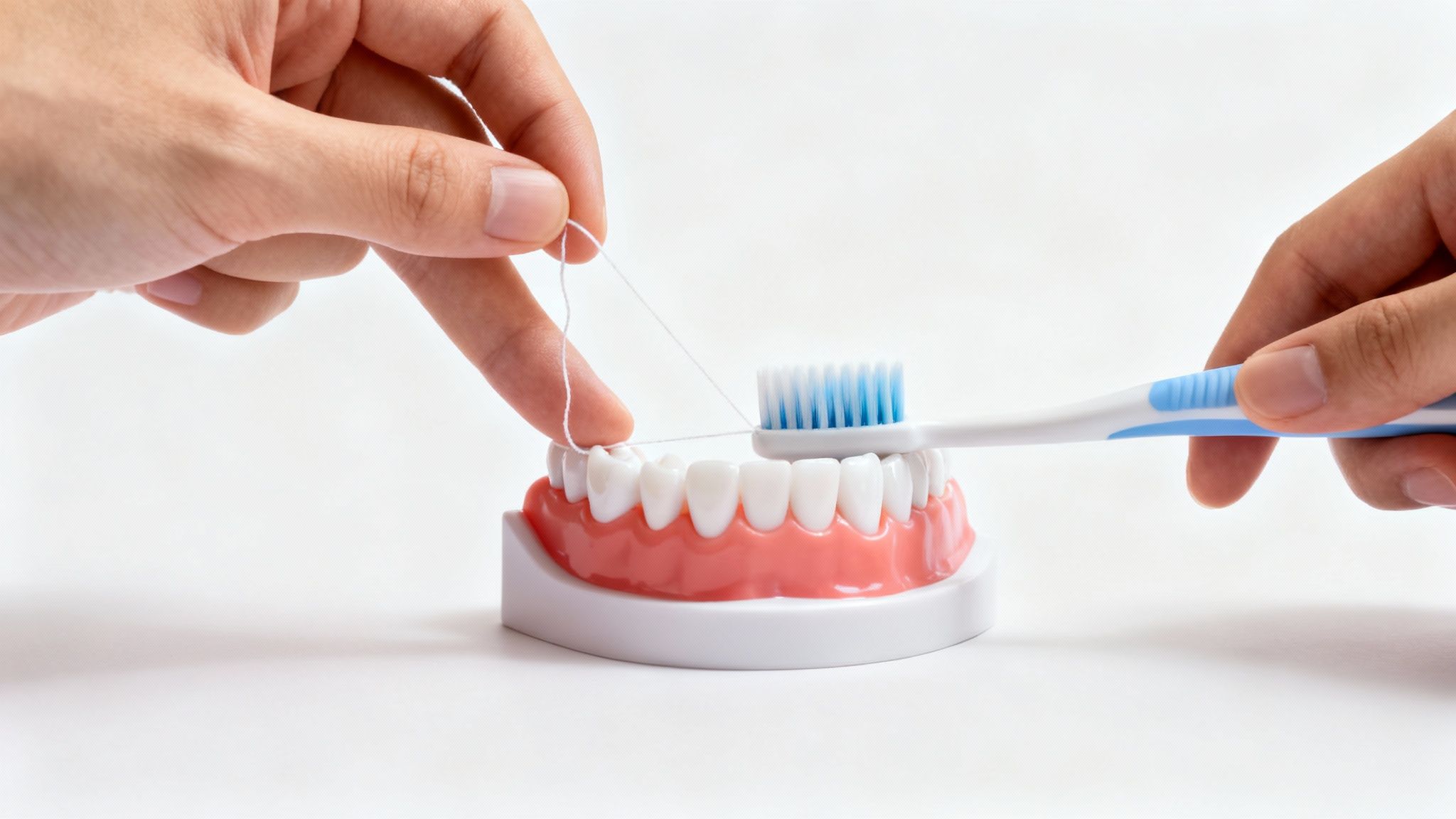
It’s not just about brushing hard; it's about brushing smart. The goal is to clean the critical area where your teeth meet your gums, where plaque loves to hide and cause irritation. For this, a technique called the Bass method is incredibly effective.
Instead of scrubbing back and forth, angle your soft-bristled toothbrush at a 45-degree angle toward your gumline. Then, use short, gentle, back-and-forth or circular motions. This helps dislodge plaque from just beneath the gum’s edge—a subtle shift in angle that makes a massive impact.
Flossing is non-negotiable for healthy gums, but technique matters. Simply snapping the floss between your teeth isn't enough. To clean effectively below the gumline, you need to use the ‘C-shape’ technique.
Gently guide the floss between two teeth. Then, wrap it into a "C" shape against one tooth, sliding it down as far as it can comfortably go beneath the gumline. You want to "hug" the tooth as you move the floss up and down a few times. Now, do the same thing for the neighboring tooth before you move on. This ensures you’re cleaning the sides of each tooth and the crucial pocket just beneath the gums.
Think of your gumline as the foundation of a house. You wouldn't just sweep the floors; you'd clean the baseboards where dust and dirt collect. The C-shape technique does exactly that, preventing the buildup that leads to gingivitis.
Your daily habits outside of your bathroom routine play a huge role in your gum health. What you eat and drink can either support your gums or sabotage your efforts.
These habits, combined with proper technique, create a powerful defense for your smile. But remember, even with perfect at-home care, professional cleanings are essential. They remove hardened plaque (tartar) that you can’t tackle on your own, making them a cornerstone of maintaining excellent gum health.
A daily self-check is a fantastic habit, but it’s the first step, not the final word on your gum health. While you can spot many early warning signs in your mirror, only a dental professional has the tools and training to see what’s happening beneath the surface.
Knowing when to put down the mirror and pick up the phone to schedule an appointment is crucial for protecting your smile from long-term damage.
While any persistent red flag is worth a call, some symptoms should move "call the dentist" to the top of your to-do list. These signs indicate that the issue may be more serious than simple inflammation and require an expert opinion right away.
Don't "wait and see" if these symptoms improve on their own. If you notice any of the following, it’s time to schedule a visit:
Knowing how to react is as important as knowing what to look for. For a deeper understanding of visit frequency and why regular check-ups are so crucial for prevention, you might be interested in our guide on how often you should visit the dentist.
Knowing what to expect during a dental exam can reduce anxiety. When your dentist focuses on your gum health, they’ll perform a few specific, painless checks to get an accurate diagnosis.
First, they will likely use a tiny measuring tool called a periodontal probe to check the depth of the pockets between your teeth and gums. Think of it as a tiny ruler. In healthy gums, these pockets are shallow, usually just 1-3 millimeters deep. Pockets deeper than that are a clue that gum disease may be progressing.
Next, your dentist or hygienist will perform a professional cleaning to remove any hardened plaque (tartar) that you can't remove at home. They'll also look at your X-rays to assess the health of the bone supporting your teeth.
This combination of visual checks, precise measurements, and imaging provides a complete and accurate picture of your gum health. From there, we can map out a personalized treatment plan to get you back on track.
As you pay closer attention to your gums, it's normal to have questions. Distinguishing a real warning sign from something normal can feel confusing at first. This is a key part of taking control of your oral health, and we hear these same questions from patients all the time.
Let's clear a few things up.
Yes, absolutely. This is one of the biggest and most dangerous myths about gum disease.
The earliest stage, gingivitis, is almost always painless. Its first clues are visual, not sensory—like redness along the gumline, puffiness, or bleeding when you brush. Pain usually doesn't appear until the disease has progressed and started causing irreversible damage to the bone and tissues holding your teeth in place.
That’s exactly why visual self-checks are so important. They help you catch the problem long before it causes pain and permanent harm.
No. It is never normal for healthy gums to bleed from routine brushing or flossing.
While being too aggressive with your toothbrush might cause some irritation, consistent bleeding—even a little pink in the sink—is a classic sign of inflamed gums.
Think of it as a direct message from your body, signaling that plaque buildup is irritating the tissue. The great news is that at this early stage, the problem can often be completely reversed with a renewed focus on thorough, gentle hygiene and a professional cleaning.
Many patients who smoke ask how that fits in. Smoking is tricky because it restricts blood flow to the gums, which can mask the bleeding that normally signals gingivitis. This creates a false sense of security, allowing gum disease to worsen silently while the most obvious warning sign is hidden.
This is a great question, and the answer depends on the stage of the disease.
This critical difference is why early detection is everything. Catching and reversing gingivitis is the single best way to prevent the permanent damage that comes with periodontitis. It’s all about acting on those first subtle signs instead of waiting for bigger problems to appear.
Your gum health is the foundation of a smile that lasts a lifetime, and you don’t have to figure it out alone. If you've noticed any of these warning signs or just want a professional to take a look for your own peace of mind, our team at Clayton Dental Studio is here for you.
Schedule your comprehensive check-up today and take a proactive step toward protecting your oral and overall health.