

Book Your Appointment Today!
Our staff will reach out to you shortly
Thank you! Your submission has been received!
Oops! Something went wrong while submitting the form.


When it comes to your oral health, the most common advice is to see your dentist every six months. This isn't just an arbitrary suggestion; it's a proven strategy for maintaining a healthy mouth and preventing minor issues from escalating into complex problems. Think of it as essential maintenance for your smile, ensuring it lasts a lifetime.

Just as you wouldn't wait for your car's engine to fail before an oil change, you shouldn't wait for a toothache to see your dentist. Regular dental visits are centered on prevention. The six-month interval is considered the optimal timeframe for a dental professional to detect potential issues—like small cavities, early-stage gum inflammation (gingivitis), or even signs of oral cancer—when they are most treatable. At this stage, treatments are typically simpler, less invasive, and more affordable.
The six-month timeline is directly related to the lifecycle of dental plaque. Even with excellent at-home brushing and flossing, the sticky film of bacteria known as plaque can accumulate in hard-to-reach areas. Over time, it hardens into tartar (calculus), which cannot be removed by brushing alone and requires a professional cleaning.
If left unchecked, tartar buildup can lead to a host of problems:
Actionable Insight: A professional cleaning every six months effectively resets your oral environment. It disrupts the plaque and tartar cycle before it can cause significant or permanent damage, forming the cornerstone of preventive dental care.
The concept of routine dental care has evolved significantly. By the mid-20th century, growing evidence showed that preventive care could drastically reduce rates of decay and gum disease. By the 1970s, about 60% of adults in the U.S. were visiting a dentist at least annually, reflecting a major shift in public health awareness. You can read more about the history of dental care statistics at premierimagedentistry.com.
While six months is the standard, your ideal schedule may vary based on your age and specific health needs. Each life stage presents unique dental challenges.
Here is a practical guide to recommended dental check-up schedules.
Adhering to a consistent schedule ensures you receive the targeted care needed to maintain a healthy smile throughout your life.
For many, a dental office can seem intimidating. However, understanding the process can demystify the experience and reduce anxiety. A dental check-up is a structured process designed to maintain your oral health and catch problems early. Your visit will typically consist of a thorough examination followed by a professional cleaning.
The first part of your visit is a comprehensive exam. Your dentist or hygienist will carefully inspect your teeth, gums, tongue, and other soft tissues. They are trained to identify subtle signs of potential problems.
Key things they look for include:
We also take digital X-rays periodically. These images allow us to see what is invisible to the naked eye, such as cavities between teeth, issues with tooth roots, or problems within the jawbone, enabling early intervention.
After the exam is the professional cleaning, which leaves your mouth feeling exceptionally fresh and smooth. This is where the preventive power of a dental visit is most apparent.
While you can remove plaque at home, once it hardens into tartar (calculus), only professional instruments can remove it. Your hygienist will use a scaler to gently remove all tartar from your tooth surfaces and just below the gumline. This step is critical because tartar buildup is a primary cause of gum disease.
Actionable Insight: A professional cleaning is the only way to remove hardened tartar. Think of it as a necessary "reset" that your toothbrush can't perform, stopping the cycle of inflammation and decay.
Finally, the hygienist will polish your teeth with a high-powered brush and a specialized gritty paste. This not only removes surface stains for a brighter appearance but also smooths the tooth surfaces, making it harder for new plaque to adhere. It is a vital finishing step for long-term protection.
Understanding the value packed into a professional dental cleaning makes it clear why it’s a cornerstone of any good health routine.
The "every six months" guideline is an excellent starting point, but it isn't a rigid rule. Your ideal dental visit frequency depends on your unique oral health profile, lifestyle, and medical history. For individuals in higher-risk groups, waiting six months can allow minor issues to develop into significant problems. A personalized schedule is key to effective long-term oral health.
Certain health conditions and lifestyle choices create an environment where oral health problems can develop more rapidly, necessitating more frequent professional care. This isn't a penalty; it's a proactive strategy to keep you healthy.
Key factors that often require visits every three to four months include:
This flowchart illustrates how your personal risk level can influence your ideal schedule.
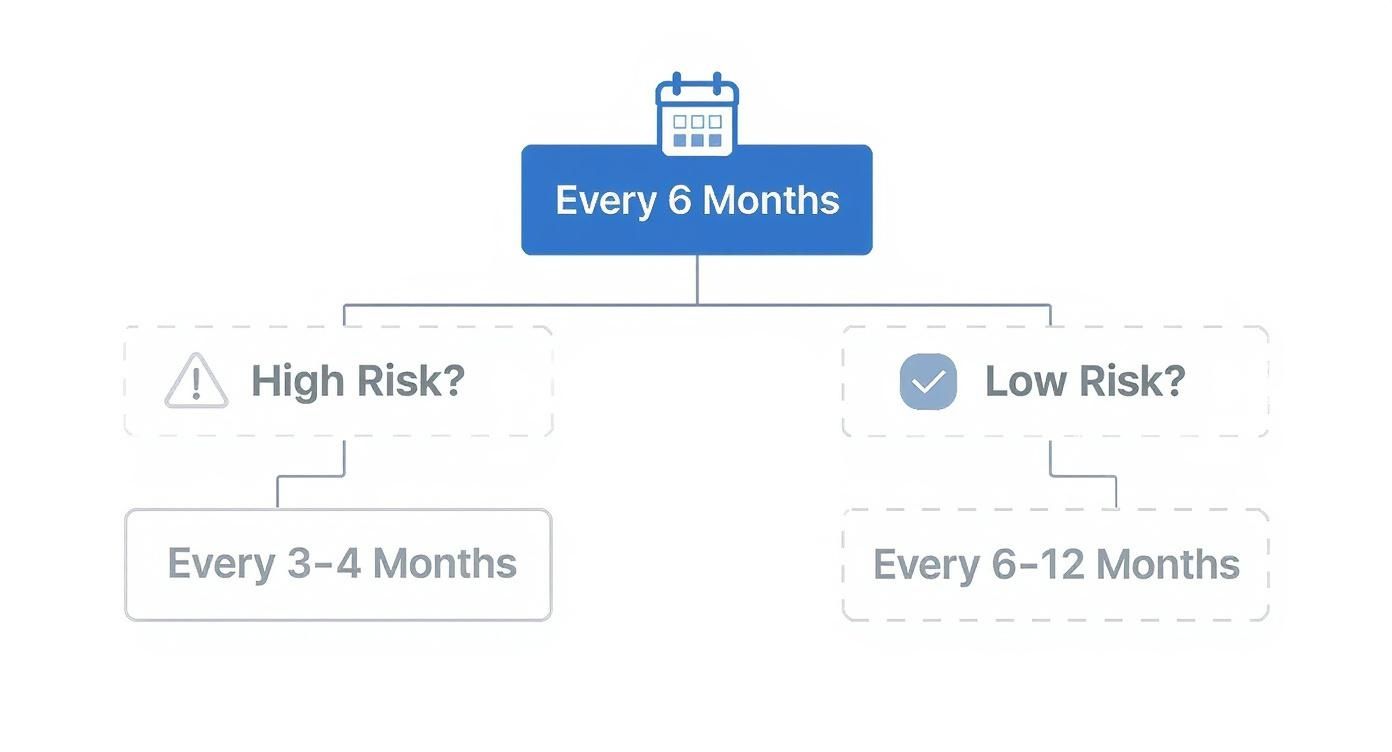
The key takeaway is that your schedule should be a dynamic plan, adjusted based on your current risk profile.
A personalized schedule also considers the deep connection between your oral and overall health. Certain risk factors make more frequent dental visits a practical necessity.
As you can see, creating the right schedule involves a comprehensive look at your health.
Your mouth is a window to your body's overall wellness. Certain medical conditions can compromise your ability to fight off dental issues, making a collaborative approach with your dentist essential.
Informative Insight: Many systemic diseases, like diabetes, can lower the body's resistance to infection, making gum disease more severe or harder to control. Adjusting your dental visit frequency is a proactive way to manage these interconnected health risks.
Consider these significant connections:
The most effective way to determine your ideal schedule is to have an open discussion with your dental team. A trusted family dentist can create a customized plan that ensures every member of your household receives care perfectly suited to their individual needs.
While your calendar may indicate your next check-up is months away, your body sometimes sends clear signals that you need professional attention sooner. Ignoring these warnings is like ignoring a strange noise from your car's engine—the problem rarely resolves itself and often worsens.
Listening to your body is a critical part of maintaining your oral health. Prompt action can mean the difference between a simple solution and a more complex, painful, and costly procedure.
Some oral health issues, while not true emergencies, should not wait until your next scheduled cleaning. Think of these as your body's "check engine" light. If you experience any of the following, it is time to call your dentist.
Common warning signs include:
Actionable Insight: Treat symptoms like pain or bleeding gums as important messages from your body. By seeking timely care, you can address issues when they are most manageable, preventing them from escalating.
It is also important to distinguish between a problem requiring a prompt appointment and a true dental emergency needing immediate, same-day attention. While the symptoms above are urgent, some situations are more critical.
A true dental emergency typically involves severe, uncontrollable pain, unstoppable bleeding, or a traumatic injury that could result in tooth loss. For severe incidents like a knocked-out tooth or a serious mouth injury, knowing what to do in the first few moments is crucial. To prepare for such events, learn what to do in a dental emergency to take the right actions before reaching our office.
The twice-a-year dental check-up, while standard in many Western countries, is far from a universal practice. A global perspective reveals how culture, economics, and healthcare policies significantly influence oral health habits.
The disparity in dental visit frequency worldwide is striking. Projections for 2025 suggest that countries like Monaco and Norway will average over 3.3 dental visits per person annually. In contrast, many nations in Latin America and Sub-Saharan Africa average fewer than 0.5 visits per person. In the U.S., the CDC reports that only about 64% of adults had a dental visit in the past year. You can explore more of these global dental visit trends at ceoworld.biz.
This comparison highlights that consistent access to professional dental care is a significant advantage for long-term health.
What drives this global gap? The answer lies in national healthcare frameworks. Countries with public health systems that subsidize or fully cover preventive dental care tend to have higher visit rates. In these nations, a dental check-up is viewed as a routine part of maintaining overall health, similar to an annual physical.
Informative Insight: In regions where dental care is routine and accessible, populations generally have better oral health outcomes, with lower rates of tooth decay and gum disease.
Conversely, in regions where dental care is paid for out-of-pocket and often considered a luxury or reserved for emergencies, visit frequency drops significantly. This global view underscores the value of the six-month recommendation as a gold standard for preventive health and reminds us not to take accessible care for granted.
Even with a clear understanding of why regular dental care is vital, you may still have questions. Here are straightforward answers to some of the most common inquiries we receive.
We find that clarifying these points helps patients feel more confident and empowered in managing their oral health.
Do I really need a check-up if my teeth feel fine?
Yes, absolutely. This is one of the most critical points to understand. Many serious dental problems, including early-stage cavities, gum disease, and oral cancer, often present with no pain or noticeable symptoms until they have advanced.
Regular visits allow your dentist to detect these issues when they are small and simple to treat. It is the most effective preventive maintenance you can perform for your health.
Actionable Insight: Waiting for pain to signal a problem is a reactive approach. Proactive check-ups are designed to find and fix issues while they are still silent and manageable, saving you from future discomfort, expense, and complex treatments.
Is visiting the dentist once a year enough?
While an annual visit is far better than none, the six-month standard exists for a reason. Plaque and tartar can build up surprisingly quickly, increasing your risk for cavities and gum inflammation.
For most people, a yearly visit is not frequent enough to stay ahead of potential problems. However, if you demonstrate exceptional oral hygiene and have a very low risk of dental issues, your dentist may approve an annual schedule after a thorough evaluation.
What if I'm too anxious to go to the dentist?
You are not alone. Dental anxiety is extremely common and is nothing to be ashamed of. The most important step you can take is to communicate your feelings with your dental team.
Modern dental practices are designed with patient comfort in mind. We can help by explaining each step of the process, offering breaks, or discussing sedation options to help you relax. Finding a dental team that listens and responds to your needs is key to transforming a stressful appointment into a positive one.
Ready to schedule the proactive care your smile deserves? The team at Clayton Dental Studio is here to provide compassionate, modern dentistry for your entire family. Book your appointment online or call us today!