

Book Your Appointment Today!
Our staff will reach out to you shortly
Thank you! Your submission has been received!
Oops! Something went wrong while submitting the form.


If you're reading this after hiding your smile in photos, chewing on one side, or worrying that a denture will look obvious, you're in very good company. Missing teeth can change small daily moments first. Ordering at a restaurant feels awkward. Certain words suddenly sound different. You may even catch yourself covering your mouth when you laugh.
That experience can feel isolating, but it isn't unusual. In 2020, approximately 41 million Americans wore dentures, and the figure was projected to rise. Globally, around 19% of people in studied countries use dentures, and in the U.S., more than 35 million people are fully edentulous, with 90% of that group wearing dentures according to these denture statistics. Dentures are not a rare last resort. For many people, they're a practical way to restore eating, speech, and confidence.
Some patients also compare local care with options farther away, including dental tourism for dentures, because cost and access matter. That comparison is understandable. What matters most is making an informed choice about fit, follow-up care, and what kind of support you'll have after delivery.
Modern dentures aren't the bulky appliances many people picture from decades ago. Today's options can be designed with better materials, better planning, and more precise fitting methods. A denture should support your life, not interrupt it.
For many patients in Humble, Houston, and Atascacita, the first real question isn't "Do dentures exist?" It's "Will they work for me?" That's the right question. The answer depends on how many teeth are missing, the health of your gums and bone, whether you want a removable or more secure option, and how much maintenance fits your lifestyle.
A good denture plan also looks beyond the teeth themselves. It considers facial support, how your bite comes together, how clearly you speak, and whether the solution will still feel manageable months from now.
Dentures aren't about replacing plastic teeth. They're about restoring comfort, function, and confidence in a way that fits your health and your daily routine.
Patients often get confused because the word "dentures" covers several different solutions. Some replace all teeth. Some replace only a few. Some go in right after extractions. Some attach to implants for much stronger hold. If you've heard conflicting advice from friends or online searches, that's usually why.
The helpful way to think about dentists and dentures is this:
That last point is easy to miss. A denture isn't a one-time purchase you never think about again. It's part of your ongoing oral health. When patients understand that early, they usually make calmer, smarter decisions.
Dentures are custom-made replacements for missing teeth and the gum tissue that supports them. The simplest way to picture them is as a puzzle piece made specifically for your mouth. They don't just fill empty spaces. They help restore shape, support, and function.
When a tooth is missing, your mouth doesn't ignore the gap. Nearby teeth can drift. Biting pressure changes. Food can collect differently. Your lips and cheeks may lose support if many teeth are gone. A denture is designed to bring order back to that system.

Most patients don't lose teeth for one single reason. It's usually a chain of events.
Sometimes it starts with a cavity that wasn't treated early enough. Sometimes gum disease slowly weakens support around the teeth. In other cases, a cracked tooth, an injury, or years of wear leaves teeth beyond repair. Whatever the path, the result is the same. You need a stable, usable bite again.
Common reasons include:
Patients sometimes think dentures replace only the visible white part of teeth. They do more than that. A denture also helps replace lost volume from the missing structures underneath, especially when several teeth are gone.
That matters because tooth loss affects more than appearance. It can change how you pronounce words, how evenly you chew, and whether your jaw feels stable when you eat.
Practical rule: If missing teeth are affecting comfort, nutrition, speech, or confidence, it's time for a denture conversation. Waiting usually doesn't make the decision simpler.
There's still stigma around dentures, and it keeps some people from seeking help. It shouldn't. Needing dentures doesn't mean you've failed. Oral health problems happen for many reasons, including medical history, past access to care, gum disease, injury, and age-related wear.
For some patients, dentures are the most conservative path. For others, they're the fastest way to get back to eating and smiling without pain. Either way, the purpose is simple. Restore what you're missing so your mouth can function again.
A denture doesn't begin in a lab. It begins in the exam chair with questions, measurements, and planning. That's where dentists and dentures really connect. The appliance matters, but the planning behind it matters just as much.
Dentists are central to this work. The profession is projected to grow 4% from 2024 to 2034, oral diseases affected 3.5 billion people worldwide in 2022, and 46% to 47% of U.S. adults over 30 have gum disease, a major cause of tooth loss, according to the U.S. Bureau of Labor Statistics overview of dentists. That same source notes that initial denture consultations typically cost between $85 and $110.
The first appointment is usually more detailed than patients expect. Your dentist isn't only checking whether teeth are missing. They're looking at gum health, jaw shape, remaining teeth, bite relationship, sore areas, and signs that another treatment might work better.
This visit is also where patients talk through goals. Some want the quickest replacement possible. Others care most about stability. Some are trying to stay within a strict budget. Those details shape the plan.
Once a plan is set, your dentist gathers the records needed to create the denture. Traditional impressions may use impression material in trays. Some offices also use digital scanning as part of a modern workflow.
Both methods aim for the same outcome. They capture the shape of your mouth accurately enough to create a denture that fits as closely as possible from the start.
Patients who are anxious about discomfort at this stage should say so. If you expect extractions or soreness, it's smart to ask your dentist or physician about pain control and medication safety. A general resource on understanding acetaminophen and codeine can help you prepare better questions before treatment.
Many people think the denture appears fully finished at the next appointment. Often, there is a try-in stage first. During this stage, your dentist checks several things:
That visit matters because small changes here can improve comfort later.
A good try-in appointment saves frustration after delivery. If something feels off, that's the time to say it.
At the final delivery visit, your dentist places the denture, checks pressure points, and explains how to insert, remove, and clean it. You may leave feeling relieved, but also aware that your mouth is adjusting.
Many new denture wearers get discouraged unnecessarily. Even a carefully made denture may need follow-up adjustments. Sore spots, looseness, or speech changes don't automatically mean the denture failed. They usually mean your dentist needs to refine the fit.
That partnership continues after delivery. The dentist checks tissue health, evaluates wear, and decides whether you need a reline, repair, replacement, or discussion about a more secure option.
Different denture types solve different problems. The best option depends on how many teeth are missing, whether your remaining teeth are healthy, and how much stability you want day to day.
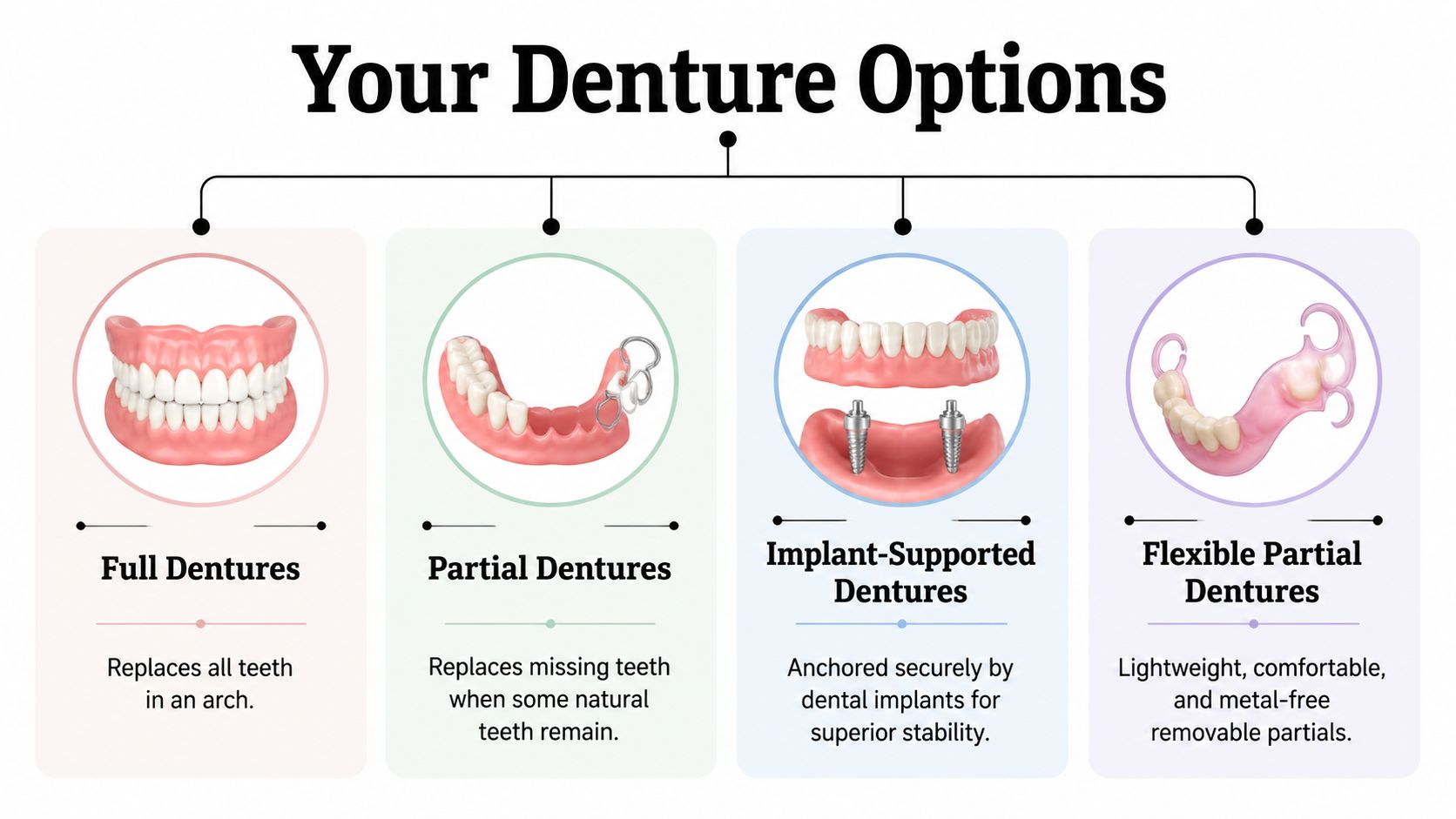
A full denture replaces all teeth in the upper arch, lower arch, or both. This option is for patients who no longer have salvageable teeth in that arch or who have already lost them.
These dentures rest over the gums and are shaped to restore the appearance of a full smile. They can improve facial support and make everyday eating and speaking easier, but they may take time to learn, especially on the lower arch where movement is more common.
This option often fits people who:
A partial denture fills gaps when some natural teeth remain. It uses those remaining teeth as part of the overall design and helps stop neighboring teeth from shifting into open spaces.
This can be a practical choice when several teeth are missing but enough healthy teeth remain to support a removable appliance. For many families, it's also a useful middle ground between doing nothing and committing to multiple fixed restorations.
An immediate denture is made before teeth are removed and placed right after extraction. Patients often like this option because they don't have to go without teeth during the healing period.
The part that confuses people is this: immediate dentures are convenient, but your gums and bone change as they heal. That means adjustments, relines, or later replacement are common parts of the process.
Immediate dentures are often about transition. They help you leave with teeth in place while your mouth settles into its healed shape.
An implant-supported denture connects to dental implants rather than relying only on the gums for support. This usually creates a more secure bite and less movement during eating or speaking.
For patients who are tired of a denture slipping, this option can change the day-to-day experience dramatically. If you want to review a local example of this treatment category, implant-retained denture care in Humble shows how this type of solution is typically described in practice settings.
Modern fabrication has improved what many patients can expect from removable dentures. According to this review of digital complete denture systems, CAD/CAM milling from high-density PMMA can eliminate polymerization shrinkage of up to 1.0% seen in conventional methods. The same review reports 50% to 70% fewer chairside adjustments, a reduction in visits from 5 to 6 down to as few as 2 to 3, and higher flexural strength of more than 100 MPa compared with 60 to 80 MPa for some conventional layered acrylics.
In plain language, that means digital dentures may fit better from the start, break less easily, and require fewer return visits.
If you're trying to sort the options mentally, use this shortcut:
The right choice isn't the one that sounds most advanced. It's the one that matches your mouth, your goals, and your ability to maintain it.
Dentures are only one category of tooth replacement. Some patients are better served by a bridge. Others are strong candidates for implants. The useful question isn't which option sounds most modern. It's which trade-offs fit your health, budget, and long-term priorities.
A removable denture can replace many missing teeth without surgery. A bridge is fixed in place and usually works best when a smaller gap sits between teeth strong enough to support it. Implants replace missing tooth roots and can support a crown, bridge, or denture.
Individuals typically notice the differences in four places first:
Implant-supported overdentures stand out for stability and bone support. According to Cleveland Clinic's denture overview, they can provide retention forces 5 to 10 times higher than conventional dentures. That source also notes alveolar ridge resorption can drop to less than 0.05 mm per year, with 60% to 80% more bone volume preserved over a decade, using 2 to 4 implants with 98% success rates.
Those are meaningful differences, but they don't automatically make implants the right answer for everyone. Some patients don't want surgery. Some need a faster path. Some only need a removable option they can manage comfortably.
| Feature | Removable Dentures (Full/Partial) | Dental Bridge | Dental Implants |
|---|---|---|---|
| How it stays in place | Rests on gums, and partials may use remaining teeth for support | Attached to neighboring teeth | Anchored in the jawbone |
| Best use case | Multiple missing teeth or full-arch replacement | One or a few missing teeth between healthy support teeth | Single, multiple, or full-arch replacement with strong support |
| Surgery required | Usually no, unless combined with extractions or implants | No implant surgery | Yes |
| Daily maintenance | Removed for cleaning | Cleaned in place with careful home care | Cleaned in place with careful home care |
| Feel during chewing | Can take time to adapt, may move more | More fixed feel than removable dentures | Most natural and stable feel for many patients |
| Effect on bone | Doesn't stimulate bone the way implants do | Doesn't replace the root in bone | Supports bone through implant function |
| Repair and adjustment | Often easier to adjust or remake | May need replacement if support teeth change | Requires implant maintenance and healthy surrounding tissues |
Bridges are often overlooked in dentists and dentures discussions because they aren't removable. But they can be excellent in the right case. If you're missing one tooth or a short span of teeth and the neighboring teeth already need crowns, a bridge may be a practical fixed solution.
The limitation is that a bridge depends on other teeth. If those teeth are weak, heavily restored, or unhealthy, the bridge may not be the smartest long-term plan.
Dentures remain highly useful when many teeth are missing, when cost matters, or when a patient wants to avoid more invasive treatment. They also work well as transitional treatment while a person considers a future implant plan.
The "best" tooth replacement is the one you can wear, clean, afford, and maintain consistently.
Implants become especially important when a patient says some version of this: "I want less movement," "I want to chew better," or "I don't want the lower denture floating around."
That doesn't always mean a full set of individual implants. Sometimes it means using implants to stabilize a denture rather than replacing every tooth separately. That's often where patients find the most realistic balance between improved stability and manageable treatment.
A strong consultation should objectively compare all three paths. A removable denture, a bridge, and implants all solve missing teeth differently. None is automatically right just because it costs more or sounds more permanent.
Cost is often the reason patients delay treatment, even after they've accepted that they need it. That's understandable. Dentures involve more than the appliance itself. The total plan may include extractions, exams, imaging, relines, repairs, temporary solutions, or implant support.
What matters is breaking the cost question into manageable parts rather than treating it like a yes-or-no decision.
Two patients can both say they need dentures and still need very different treatment. One person may need a basic removable partial. Another may need full dentures after extractions. Another may need implant support because a standard lower denture won't be stable enough for their goals.
Coverage also complicates the picture. For many patients, Medicaid coverage limitations create significant barriers to denture access, and patient-facing explanations often don't connect policy limits with real-world affordability. The American Dental Association resource on dental care access for vulnerable populations also highlights why in-house membership plans and financing options like CareCredit can be practical tools for budget-conscious or uninsured patients.
If you're trying to make dentures fit your budget, these are the conversations worth having:
Patients caring for an older parent or relative may also benefit from a broader practical Medicaid dental guide for caregivers, especially when trying to sort out what may or may not be covered.
If you're in Humble or nearby, it helps to review a local breakdown of affordable dental care options in Houston before scheduling treatment. That kind of resource can make it easier to compare membership plans, financing, and the likely sequence of care.
Bring these to your consultation:
The key is not chasing the cheapest denture in isolation. A low upfront fee can become frustrating if it doesn't include the support, adjustments, or planning you need.
The first weeks with dentures are an adjustment period, not a test you're supposed to pass perfectly. Most new wearers need time to learn how the denture sits, how food feels, and how their speech changes. Small frustrations are common and manageable.
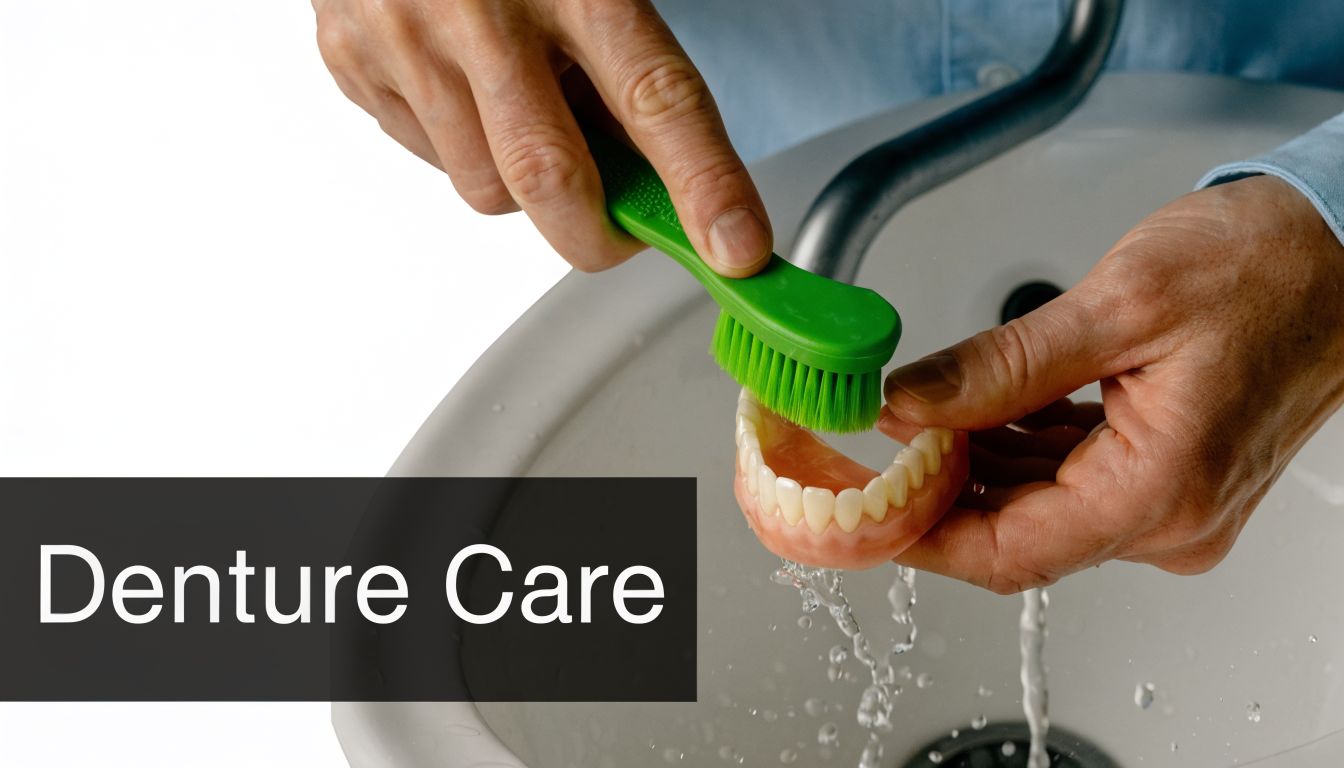
A simple routine prevents many of the problems that make dentures uncomfortable.
If you want a local reference for maintenance and follow-up needs, denture care guidance in Humble outlines the kinds of services patients often need after delivery.
Start with softer foods cut into smaller bites. Chew slowly and try to use both sides of your mouth at the same time so the denture stays more balanced.
Speech usually improves with practice. Reading out loud at home often helps patients adapt faster to sounds that feel different at first.
If a word feels hard to pronounce, repeat it rather than avoiding it. Your tongue and cheeks are learning a new shape.
This short video can help you think through common care habits and expectations:
Here are the issues patients mention most often:
What shouldn't happen is trying to solve every problem with more adhesive. Adhesive can help in the right situation, but it doesn't replace a proper fit.
Call if you notice any of the following:
Professional adjustments matter because even a small pressure area can become a bigger sore if ignored. Denture success usually comes from follow-up care, not from trying to "tough it out."
Modern dentures can do much more than fill a gap. They can help you eat more comfortably, speak with less self-consciousness, and feel like yourself again. For some people, a removable denture is the right answer. For others, a partial, immediate denture, bridge, or implant-supported option fits better. The important part is getting a plan that matches your mouth and your life.
If you've been hesitating because the process feels confusing, that's normal. Most patients don't need more sales language. They need clear explanations, realistic expectations, and a dentist who will tell them what makes sense now and what can wait.
That kind of conversation matters in real life around Humble, Atascocita, and the greater Houston area, where families are balancing health needs, work schedules, and budgets at the same time. A careful consultation can sort out whether you're dealing with a short-term transition, a long-term removable solution, or a case where implant support would improve stability enough to be worth considering.
One practical option in that discussion is Clayton Dental Studio, which provides denture-related care along with digital imaging, implant-retained denture treatment, and affordability pathways such as financing and an in-house savings plan. For many patients, having those conversations in one place makes the decision process less overwhelming.
If you're ready, the next step is simple. Schedule a consultation, bring your questions, and talk through the choices with a dentist who can examine your mouth directly. Clayton Dental Studio is located at 12235 Will Clayton Parkway, Suite #4, Humble, TX 77346.
If you're ready to replace missing teeth and want a clear, practical plan, contact Clayton Dental Studio to schedule a denture consultation. You can ask about full dentures, partials, immediate dentures, implant-retained options, aftercare, and payment solutions that fit your budget.