

Book Your Appointment Today!
Our staff will reach out to you shortly
Thank you! Your submission has been received!
Oops! Something went wrong while submitting the form.


A bad toothache rarely shows up at a good time. For many families in Humble, it starts at the kitchen table late at night, with one hand on the jaw and the other on a phone, searching for cheap teeth extractions and hoping the price won't be worse than the pain.
That search can feel frustrating fast. One office looks affordable until add-on fees appear. A charity clinic sounds helpful, but you don't know how long the wait will be. A low price for removing the tooth might solve today's emergency, yet leave you with a bigger problem later if no one talks to you about healing or replacement.
If you're in that position, you don't need pressure. You need clear information, honest expectations, and a safe path that fits your budget.
A lot of patients start in the same place. The tooth hurts when they chew. Cold water stings. Sleep gets harder. Then the financial worry kicks in, especially if they don't have dental insurance.

In real life, the question usually isn't just, "How do I get this tooth out?" It's more like, "How do I fix this without getting trapped in a bill I can't manage?" That's a fair question, and it's why many local patients start by reading about affordable dental care options in Houston before they ever call a dental office.
Pain doesn't always send people straight to the dentist. Cost worries, work schedules, child care, transportation, and fear of the procedure all get in the way.
Common thoughts I hear from patients include:
Practical rule: If you're searching for cheap teeth extractions because the pain is interfering with eating, sleeping, or focusing, it's time to get examined. Waiting usually doesn't make treatment simpler.
Start with three questions:
Those three questions can protect you from surprise costs and rushed decisions. They also help you compare providers in a way that makes sense when you're stressed and in pain.
The price of an extraction depends first on what kind of extraction you need. That's the part many patients don't realize when they see ads for low-cost dental care.
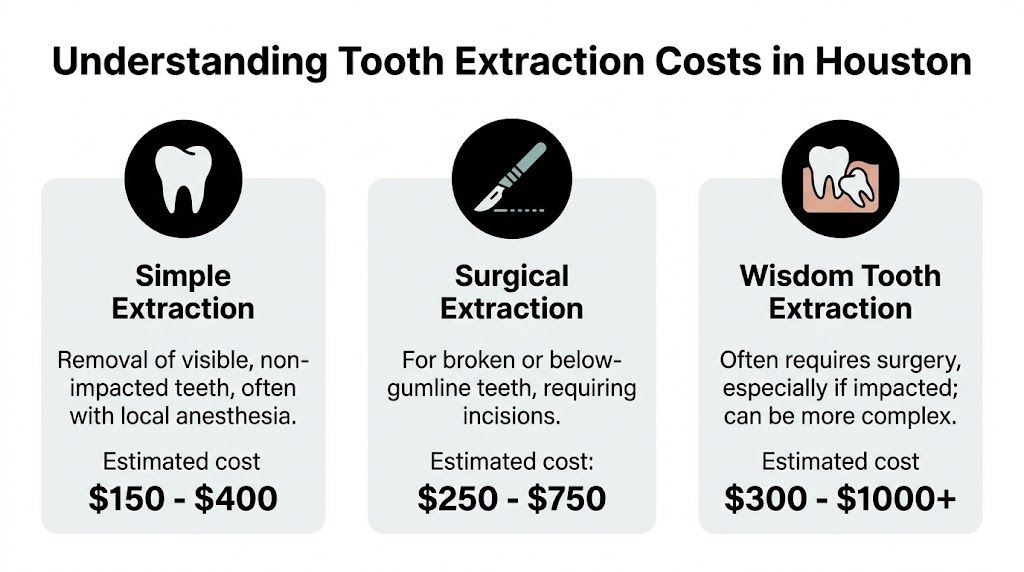
A simple extraction is usually for a tooth that's visible above the gumline and can be removed with standard instruments under local anesthesia. A surgical extraction is more involved. That may be necessary if the tooth is broken, harder to reach, or below the gumline.
According to CareCredit's tooth extraction cost overview, the national average for a simple tooth extraction is $177, with a range of $137 to $335. In Texas, the average is $162. By comparison, surgical extractions average $363 nationally.
Those figures give you a useful baseline. They don't mean every office will charge exactly the same amount, and they don't tell you whether additional services are included. But they do show that a straightforward extraction can be more affordable than many patients expect, especially when the case is simple.
Here's one way to look at it:
Type of careWhat it usually meansCost baselineSimple extractionTooth is visible and easier to remove$177 national average, $162 in TexasSurgical extractionTooth is broken, difficult to access, or below the gumline$363 national average
A low number in an ad may not include the full visit. Some offices separate the extraction fee from diagnostics or comfort-related services.
Add-ons can matter:
Ask for a written explanation of what's included before you commit. A good estimate should make it clear whether you're paying only for removal of the tooth or for the visit, imaging, and aftercare instructions as well.
Patients often search for "cheap teeth extractions" as if every extraction is the same procedure. It isn't. The question is whether your tooth qualifies for the lower-cost, simpler approach or whether the condition of the tooth makes treatment more involved.
That distinction can save you from comparing apples to oranges when you call different offices.
If you're uninsured or watching every dollar, you may look at several types of providers. That's smart. The key is to compare them by value, not just by the first number you hear.
Some charitable programs offer extractions at very low prices. A reported example comes from Side Effects Public Media's coverage of $5 extraction events, which noted that some events charged $5 per tooth. The same report said one clinic, Smiles of Hope, had extracted over 5,500 teeth since 2015.
That tells us two things. First, the need is real. Second, ultra-low-cost care can be a lifeline for people with no other immediate option.
Still, patients should ask practical questions before relying on an event like this:
Community clinics can be helpful for patients who need lower fees. Dental schools may also offer reduced-cost treatment in some settings. These options can work well for planned care when a patient has time to schedule ahead and doesn't need immediate treatment.
The trade-off is usually convenience. You may face longer scheduling timelines, a more limited treatment menu, or less continuity if your needs change after the extraction.
For many families, a private office becomes the best fit when they need three things at once:
The phrase cheap teeth extractions can be misleading. The lowest posted fee isn't always the option that gives you the safest and smoothest outcome.
Low upfront pricing helps only if the care is timely, the diagnosis is correct, and the office can guide you after the tooth comes out.
Use this checklist when comparing options:
Those questions often reveal more than the advertised price.
A very low extraction fee can feel like a win when you're hurting and worried about money. But if the conversation ends with removing the tooth and nothing else, the long-term cost can be much higher.
Your mouth doesn't stay frozen in place after an extraction. The area begins to heal, and the missing tooth changes how that part of your bite functions.
According to this discussion of affordable extraction and long-term consequences, the extraction site can experience up to 25% bone loss in the first year if no replacement plan is made. That same source notes that a future dental implant may cost $3,000 to $5,000.
That doesn't mean every extracted tooth must be replaced in the same way, or right away. It does mean the decision shouldn't be treated like a one-day transaction with no follow-up thought.
A bargain extraction can turn costly when these issues aren't discussed:
A patient trying to save money today may unintentionally choose the path that creates a larger bill later.
Affordable doesn't mean "lowest fee, no questions asked." Affordable means the care solves the immediate problem without setting you up for a harder, more expensive problem next.
Consider the difference:
ChoiceShort-term effectLong-term effectLowest upfront extraction onlyImmediate reliefMay leave bone loss and replacement decisions unaddressedExtraction with a treatment planRelief plus guidanceHelps you understand healing and future options
A safe extraction isn't just about getting the tooth out. It's about knowing what that missing tooth means for the rest of your mouth.
Don't ask only, "What's the cheapest extraction near me?"
Ask, "What will this decision cost me over time?"
That one shift in thinking helps patients avoid rushed care that looks inexpensive at first but creates more treatment later.
Fear usually gets smaller when the process becomes clear. Most simple extractions are straightforward, controlled, and much faster than people expect.

The visit starts with an exam and imaging so the dentist can see the tooth's shape, position, and condition. This step matters because it helps determine whether the tooth can be removed easily or whether it needs a more involved approach.
You'll also talk about your health history, medications, and symptoms. If the tooth can be treated another way, your dentist should tell you. If extraction is the best option, you should leave that conversation understanding why.
A simple extraction is usually done with local anesthesia. The area is numbed so you shouldn't feel sharp pain during treatment.
According to Advanced Smiles Marion's overview of simple tooth extraction, a simple extraction is typically completed in 20 to 40 minutes, the dentist uses instruments to sever the periodontal ligament and remove the tooth, the procedure has a 95% success rate, and dry socket occurs in less than 5% of cases with proper aftercare.
What you'll likely feel is pressure, not pain. Pressure can feel strange if you've never had a tooth removed, but it isn't the same as the toothache that brought you in.
Here's a brief visual explanation of the process:
Healing starts with protecting the blood clot in the socket. That's what your body uses to begin repair.
Your aftercare instructions may include guidance like:
If you'd like a more detailed recovery guide, this explanation of how to recover from tooth extraction walks through the basics in patient-friendly language.
Most patients feel better once they know what the procedure actually involves. The unknown is often scarier than the extraction itself.
Call your dental office if pain seems to worsen instead of improve, if bleeding doesn't settle, or if something about the healing feels off. Patients do best when they treat follow-up questions as normal, not as a bother.
That kind of support is part of safe care.
When patients search for cheap teeth extractions, they usually want two things that can feel hard to find together. They want a bill they can manage, and they want treatment they can trust.
The best solution is rarely the one that is merely cheapest on paper. It's the option that combines a clear diagnosis, transparent pricing, dependable follow-up, and a realistic plan for what comes next.
A responsible extraction visit should give you more than a quick removal. It should include a conversation about whether the tooth is simple or surgical, what your total expected cost looks like, and what the missing tooth may mean for your bite and future treatment.
For many families in Humble, Atascocita, Kingwood, and the greater Houston area, affordability also depends on how the office helps you pay, not just the sticker price of the procedure.
That may include:
A practice that can diagnose, treat, and guide follow-up care helps you avoid fragmented treatment. That matters when you're dealing with pain, taking time off work, or trying to coordinate care for a family.
The stronger financial choice is often the office that helps you make a sound decision the first time. That's especially true if the office can explain replacement options early, instead of leaving you to deal with a missing tooth months later.
If you're in pain and need to know whether your tooth can be removed safely and affordably, the most useful next step is to schedule an exam with a local office that handles urgent dental problems and explains fees clearly. Patients in Humble can start with this page on tooth extraction treatment in Humble TX.
You shouldn't have to choose between ignoring the pain and gambling on the lowest price you can find.
During the procedure, the area is numbed with local anesthesia, so you should feel pressure more than pain. Afterward, some soreness is normal, but your dentist will give you instructions to make healing easier.
According to Village Smiles Dental's extraction aftercare guidance, dry socket affects 3% to 5% of patients. That same source notes that salt water rinses can reduce pain by 40%, and that following aftercare instructions is especially important for seniors and children.
Sometimes yes, especially when the problem is urgent and the tooth is suitable for extraction. The dentist still needs to examine you first and confirm the right treatment plan.
Not always. A lower fee may be appropriate in some situations, but the best value comes from safe treatment, clear communication, and support after the procedure.
You're not alone. Many patients seek care without dental insurance. In those situations, ask about written estimates, membership plans, and financing options so you can compare the total cost of care, not just the extraction fee.
If you're dealing with tooth pain and need a safe, budget-conscious plan, Clayton Dental Studio offers compassionate care for families in Humble, Atascocita, Kingwood, and the greater Houston area. The team can help you understand whether you need a simple or surgical extraction, explain payment options clearly, and guide you toward treatment that protects both your health and your budget.