

Book Your Appointment Today!
Our staff will reach out to you shortly
Thank you! Your submission has been received!
Oops! Something went wrong while submitting the form.


The best material for a dental crown depends on a balance of strength, aesthetics, and the tooth's location. For most teeth, especially molars, zirconia offers an ideal blend of durability and a natural look. For front teeth where appearance is paramount, E-max (lithium disilicate) is unmatched for its lifelike translucency. For patients prioritizing extreme longevity in back molars, gold alloys remain a highly durable option.
Ultimately, the right choice is a collaborative decision between you and your dentist, based on your specific clinical needs, cosmetic goals, and the unique demands of your bite.
Deciding on a dental crown is a significant step toward restoring your smile's health and function. The material you and your dentist select will directly impact the crown's longevity, appearance, and how it feels in your mouth. This guide provides actionable information to help you understand the practical differences between the most common materials used at Clayton Dental Studio.
Choosing the right material involves a detailed discussion where we evaluate several key factors together:
To provide a clear overview, we've created a comparison of the top materials we use to craft durable, beautiful restorations for our patients in Humble and Houston.
This table offers a snapshot of the most popular crown materials, highlighting their key characteristics to serve as a starting point for your consultation.
As the data shows, each material serves a specific purpose. Our goal is to align the material's properties with your tooth's functional and aesthetic needs.
The functional demands on a front tooth crown are entirely different from those on a back molar. This is why a personalized recommendation based on a thorough examination is crucial—there is no single "best" material for every situation.
Modern dentistry increasingly favors ceramic crowns for their superior performance. Ceramics are projected to constitute 48.55% of the dental crown market by 2026, a testament to their clinical success and patient satisfaction. You can read more about these market trends from Fortune Business Insights. These advanced materials offer an optimal combination of natural aesthetics, robust strength, and excellent biocompatibility.
This comparison provides a foundational understanding, but we will explore each option in greater detail. To learn about the entire process, check out our guide on the dental crown procedure.
When patients ask for the best all-around material for a dental crown, zirconia is consistently at the top of the list. This modern ceramic has revolutionized restorative dentistry by providing an exceptional combination of mechanical strength and natural-looking aesthetics. Zirconia performs well across nearly every metric, from long-term durability to biocompatibility.

A key benefit of zirconia is that it is 100% metal-free. This eliminates concerns about metal allergies and the dark grey line that can appear at the gumline with older porcelain-fused-to-metal (PFM) crowns. It is a clean, biocompatible option that integrates harmoniously with your oral tissues.
Zirconia is renowned for its exceptional strength and fracture resistance, making it the ideal choice for posterior teeth like molars and premolars. These teeth endure the most significant forces from chewing and grinding, and zirconia is engineered to withstand this pressure, delivering a restoration designed for longevity.
A monolithic zirconia crown, milled from a single block of the material, offers maximum durability. It is significantly less prone to chipping compared to porcelain-layered crowns, providing you with the confidence to eat a full range of foods without worry. The restored tooth will function just like a healthy, natural one.
While its strength is a primary feature, modern zirconia materials also offer excellent cosmetic properties. Today's zirconia is available in a wide spectrum of shades and translucencies, enabling us to fabricate crowns that blend flawlessly with adjacent teeth.
Zirconia successfully bridges the gap between pure functional strength and high-end cosmetic dentistry. Its ability to be precisely color-matched and shaped allows us to restore a damaged tooth with predictable and aesthetically pleasing results.
This versatility explains why zirconia's use in dentistry is projected to grow by 9.8% between 2025 and 2030. Furthermore, clinical studies demonstrate that zirconia crowns have an impressive 98% survival rate at the five-year mark, confirming their reliability as a long-term solution. You can read more about zirconia's rise in dentistry from Grand View Research.
At Clayton Dental Studio, we leverage state-of-the-art technology to streamline the crown placement process. Zirconia is fully compatible with our in-office CAD/CAM systems, allowing us to design, mill, and place your final custom-fit crown in a single visit. This eliminates the need for messy impressions, temporary crowns, and a follow-up appointment.
This same-day process ensures precision and quality. Our in-house milling unit gives us complete control over the final aesthetics and fit of your crown, guaranteeing an optimal result. If you are interested in the technology, you can learn more about our Glidewell milling system and how it enables us to create durable restorations efficiently.
When the primary objective is a restoration so natural it is indistinguishable from your own teeth, E-max crowns are the preferred solution. Fabricated from lithium disilicate, a high-strength glass-ceramic, this material is celebrated for its stunningly lifelike appearance. E-max is a cornerstone of cosmetic dentistry, particularly for teeth in the anterior "smile zone."
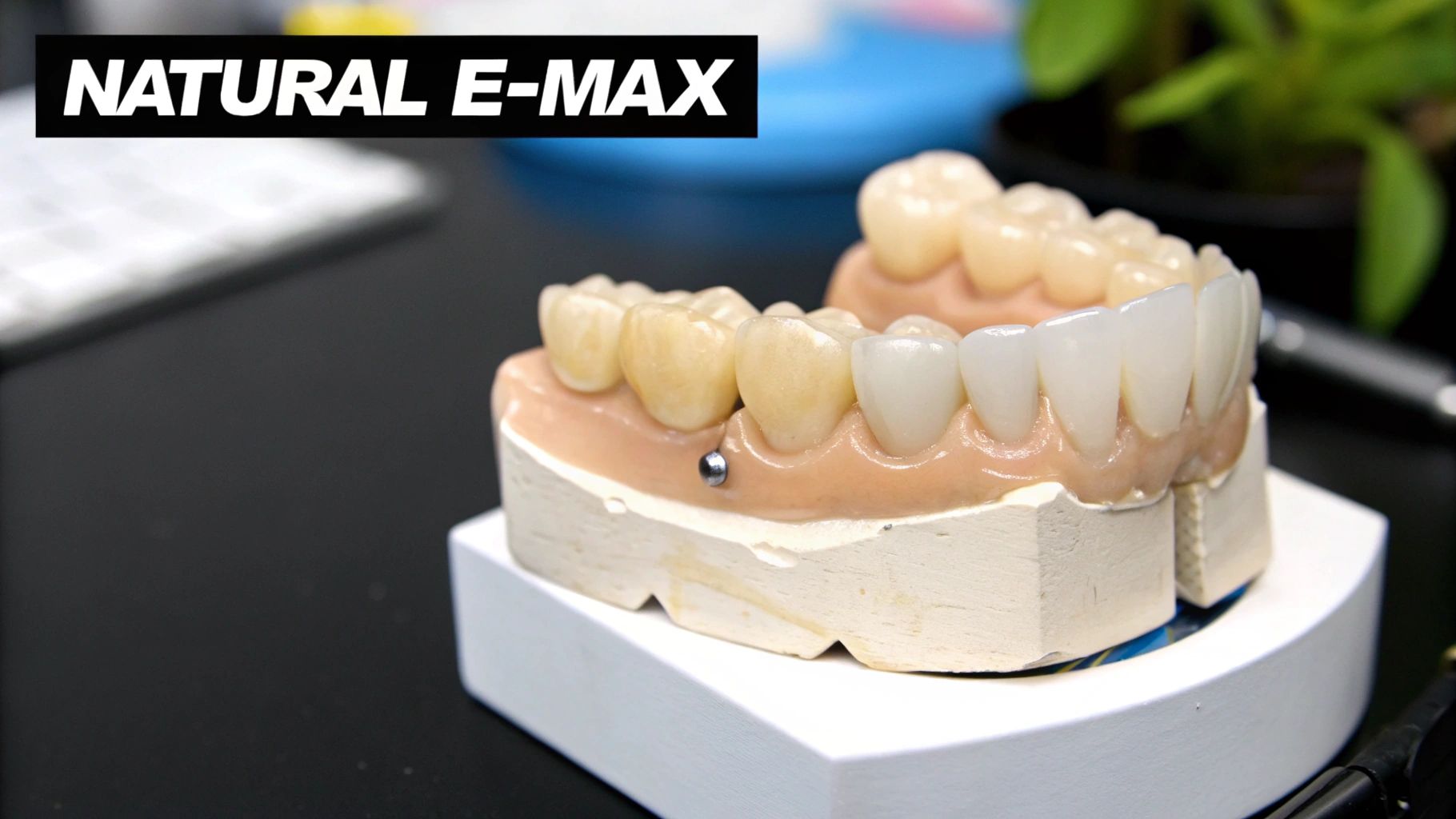
The key to its aesthetic success lies in its optical properties. E-max possesses a remarkable translucency that perfectly mimics how natural tooth enamel interacts with light. Unlike more opaque materials that can appear flat or artificial, E-max allows light to pass through it, creating depth and vitality that is difficult to differentiate from a natural tooth.
E-max is considered an ideal material for artistic dental restorations. Its ability to be custom-shaded and glazed provides our team at Clayton Dental Studio with the control needed to create a restoration that perfectly matches the unique characteristics and color variations of your smile. This level of detail makes it the optimal choice for front teeth, including incisors and canines.
Key aesthetic advantages of E-max include:
This material's versatility extends beyond full crowns to other cosmetic restorations where a natural look is essential, such as dental veneers, inlays, and onlays.
When restoring a single front tooth, the primary challenge is to make it blend invisibly with its natural neighbors. E-max provides the necessary tools to achieve this undetectable result, which is the hallmark of superior cosmetic dentistry.
While E-max is lauded for its aesthetics, it is also sufficiently durable for its intended applications. It offers good resistance to fracture and wear, especially when properly bonded to the underlying tooth structure. This makes it a reliable choice for most teeth within the smile zone that are not subjected to heavy chewing forces. A well-maintained E-max crown can be expected to last 10-15 years or longer.
However, its strength profile differs from that of zirconia. E-max is best suited for single crowns on anterior teeth and premolars. For back molars that endure intense grinding forces or for patients with bruxism, the superior toughness of monolithic zirconia is nearly always the more practical and durable recommendation.
The decision between E-max and zirconia often involves balancing aesthetic desires with functional requirements. Here is a clear breakdown of when E-max is typically the superior choice:
During your consultation at Clayton Dental Studio, we will help you evaluate these factors. We will conduct a thorough assessment of your bite, the tooth's location, and your cosmetic goals to recommend the material that will provide a beautiful, healthy, and long-lasting result.
For many years, Porcelain-Fused-to-Metal (PFM) crowns were the standard of care in restorative dentistry. They are constructed with a durable metal alloy core covered by a layer of tooth-colored porcelain. This classic hybrid design has successfully restored millions of smiles, making it one of the most trusted and predictable options in dentistry.
The success of a PFM crown lies in its metal substructure, which provides exceptional strength and rigidity. This makes it strong enough to handle the significant chewing forces exerted on posterior teeth. The porcelain is then fused over the metal core to provide a natural-looking appearance that blends with surrounding teeth.
The dual-layer construction of PFM crowns offers a unique compromise. While all-ceramic materials like E-max provide superior aesthetics and zirconia offers unparalleled strength, PFM delivers a functional middle ground. This often makes it a practical and more cost-effective choice for many patients.
PFM crowns remain a viable solution for:
While new ceramic materials are projected to hold a 48.55% market share by 2026, PFM remains a valid clinical option. However, it's important to note that PFM crowns have a 10-year success rate of 80-85%. This is slightly lower than modern ceramics, primarily due to a 5-10% incidence of porcelain chipping over time. You can review the latest trends and performance data for dental materials here on openpr.com.
Despite their proven durability, PFM crowns have several cosmetic limitations. The primary issue is the potential for the metal base to become visible over time.
The most common aesthetic concern with PFM crowns is the appearance of a "dark line" at the gumline. If the gums recede even slightly, the metal margin of the crown can become exposed, detracting from an otherwise natural-looking smile.
Additionally, the porcelain layer, while durable, can sometimes chip or fracture under stress, exposing the dark metal underneath. The opaque metal base also prevents light from passing through the crown as it does with a natural tooth, which means PFM crowns cannot replicate the translucency of E-max or high-translucency zirconia. This makes them a less-than-ideal choice for highly visible front teeth where aesthetics are critical.
At Clayton Dental Studio, we provide clear, evidence-based recommendations. While modern all-ceramic crowns have raised the cosmetic standard, we recognize that PFM is still the best material for a dental crown in specific clinical situations where proven strength and cost-effectiveness are the highest priorities.
Selecting the best material for a dental crown is a strategic decision that depends heavily on the tooth's specific function and location within the mouth. The requirements for a front incisor are entirely different from those for a back molar, which is why a personalized recommendation is essential for a successful, long-lasting restoration.
This is analogous to choosing tires for a vehicle. You wouldn't equip an off-road truck with thin racing tires. Similarly, the beautifully translucent material ideal for a front tooth may not be robust enough for the heavy grinding forces a molar endures daily.
Your anterior teeth—the incisors and canines—are central to your smile's appearance. When one of these teeth requires a crown, aesthetics are the top priority. The objective is to create a restoration so lifelike that it is indistinguishable from the adjacent natural teeth, perfectly matching their color, shape, and translucency.
For this highly visible "smile zone," two materials are the clinical standards:
When restoring a front tooth, the ultimate test is whether the crown is detectable. Both E-max and anterior zirconia provide the necessary artistic and technical properties to achieve the seamless, natural result our patients expect.
Your premolars, located behind the canines, serve a dual function: they are involved in chewing but are also visible when you smile. This requires a crown material that effectively balances both strength and aesthetics.
Zirconia is frequently our top recommendation for premolars because it offers an ideal combination of robust durability and excellent cosmetic results. It is strong enough to withstand chewing forces and can be precisely color-matched to blend in with the surrounding dentition. While E-max can be an option, zirconia provides an extra margin of safety against fracture, particularly for patients with grinding or clenching habits.
This flowchart analyzes the pros and cons of Porcelain-Fused-to-Metal (PFM) crowns, which are sometimes considered for premolars due to their proven strength.
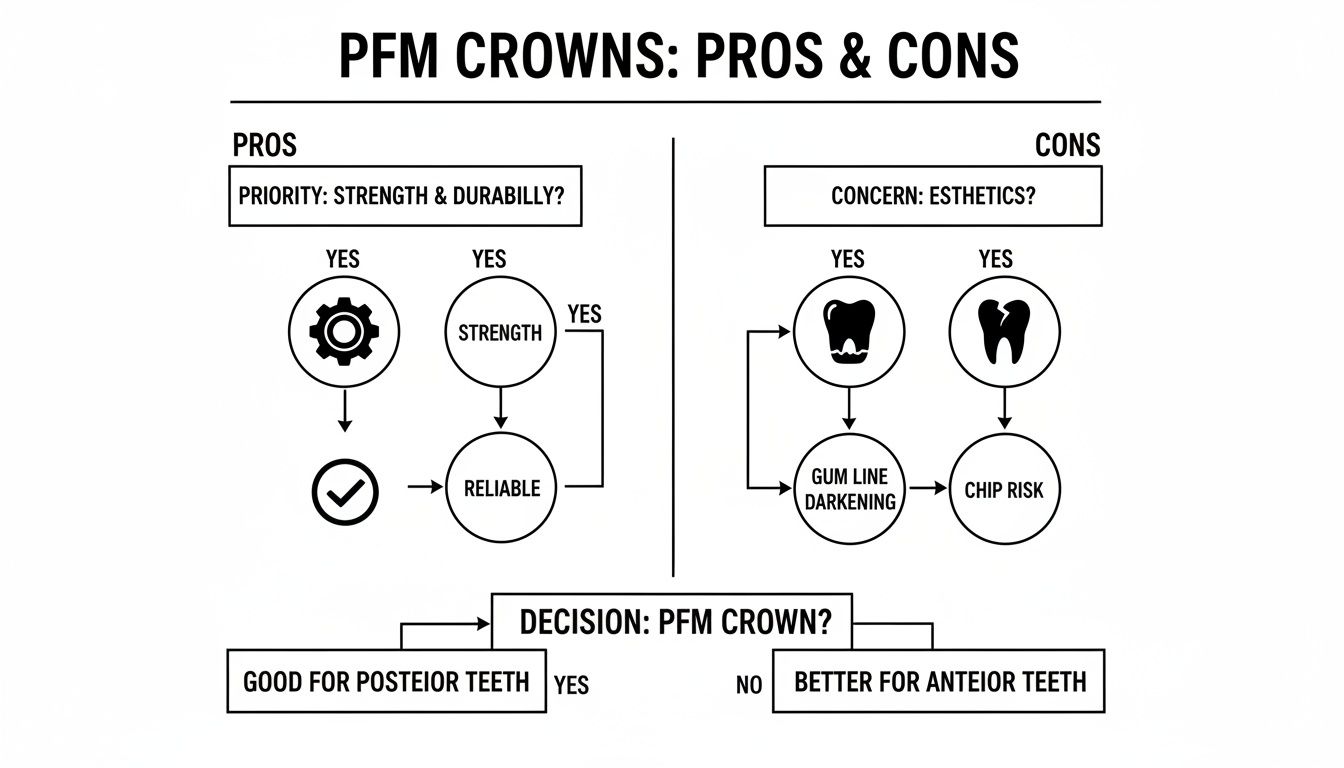
As illustrated, PFM is a reliable material but comes with potential aesthetic compromises, such as the risk of porcelain chipping or a dark line appearing at the gum line over time.
For your molars, the primary objective is uncompromised strength. These teeth bear the brunt of your bite force, grinding and crushing food daily. For these workhorse teeth, durability and longevity are far more critical than subtle aesthetics.
The definitive materials for molar crowns are:
To clarify these recommendations, let's summarize them by tooth location.
This table provides a clinical guide to the best material choices based on the specific location and functional demands of the tooth.
Ultimately, the best crown is one that functions so naturally you forget it is there. By carefully matching the material to the tooth's role, we can ensure your restoration not only looks great but also provides reliable service for many years.
Choosing the right material for your dental crown is a clinical decision, but we understand that it is also a financial one. At Clayton Dental Studio, we are committed to complete transparency. Our goal is to help you make an informed decision for your long-term oral health without financial barriers.
Several factors influence the final cost of a crown. The material itself is the primary variable—advanced ceramics like E-max and zirconia have a higher upfront cost due to the sophisticated technology and materials involved in their fabrication. The complexity of your specific case, such as the need for preliminary procedures, will also affect the overall investment.
To provide a clear understanding of what to expect, here is a general cost breakdown for different crown types. Please note that these are typical ranges; we will provide a precise, personalized estimate during your consultation.
A dental crown is a long-term investment in your health, function, and confidence. We are dedicated to finding a solution that fits your clinical needs, cosmetic goals, and financial situation.
We are committed to making your dental care accessible and affordable. Our administrative team is highly experienced in maximizing your dental insurance benefits to help cover the cost of your crown. We will manage all the paperwork and clearly explain your coverage to ensure there are no surprises.
For any remaining balance, or for patients without insurance, we offer several flexible solutions. We partner with trusted third-party financing companies like CareCredit and Cherry, which allow you to divide the cost into manageable monthly payments, often with low- or no-interest options.
Additionally, our in-house Humble Savings Plan is an excellent alternative for individuals and families without dental insurance. This membership plan offers significant discounts on crowns and other restorative treatments, making high-quality care affordable. To explore how these options can work for you, learn more about our dental in-house financing solutions.
It is natural to have questions when considering a dental crown. To help you feel fully informed and confident in your decision, we have compiled answers to the questions we hear most frequently from our patients.
The longevity of a dental crown depends on two primary factors: the material selected and your oral hygiene practices. Generally, a crown can be expected to last between 5 and 15 years, but many can function effectively for much longer.
Of course, regular dental check-ups at Clayton Dental Studio are crucial for maximizing your crown's lifespan. We will monitor the crown and the underlying tooth to address any potential issues before they become significant problems.
A dental crown is a long-term restoration, but it is not permanent. It acts as a durable, protective cap for your tooth that will serve you well for many years, but like any dental work, it may require maintenance or replacement in the future.
No, a special care routine is not required. The best way to care for your crown is to treat it like a natural tooth. The primary goal is to maintain the health of the underlying tooth and the surrounding gum tissue.
This means adhering to fundamental oral hygiene practices: consistent brushing twice a day and flossing daily. Pay close attention to the area where the crown meets the gum line, as this is where plaque can accumulate.
Traditionally, receiving a crown has been a two-visit procedure. The first appointment involves preparing the tooth, taking an impression for the dental laboratory, and placing a temporary crown. You would then return for a second visit to have the permanent, custom-fabricated crown bonded to your tooth.
However, modern technology has streamlined this process. At Clayton Dental Studio, we are proud to offer same-day CEREC crowns. For materials like zirconia, this technology allows us to design, mill, and place your final, perfectly fitted crown in a single appointment, which is a significant convenience for our patients.
Ready to restore your smile with a crown that looks, feels, and functions like a natural tooth? The team at Clayton Dental Studio is here to guide you through every option and help you select the perfect material for your needs.