

Book Your Appointment Today!
Our staff will reach out to you shortly
Thank you! Your submission has been received!
Oops! Something went wrong while submitting the form.


Considering straightening your teeth as an adult? You’re in good company. Orthodontic treatment is more common and accessible than ever, with options ranging from nearly invisible aligners to advanced braces designed for modern lifestyles. This guide offers actionable insights into your choices, treating this as a key investment in your long-term oral health and confidence. Your ideal solution will depend on your daily routine, budget, and specific dental goals.
The trend of adults seeking orthodontic treatment is growing, and for practical reasons: a well-aligned smile is now understood as a cornerstone of overall health, not just a cosmetic upgrade. This shift in perspective is driving significant growth in the orthodontics field.
The global orthodontics market was valued at USD 7.61 billion and is projected to reach USD 26.02 billion by 2032. This statistic, tracked by Fortune Business Insights, reflects a major cultural shift where adults view orthodontic care as a valuable investment in their personal and professional well-being.
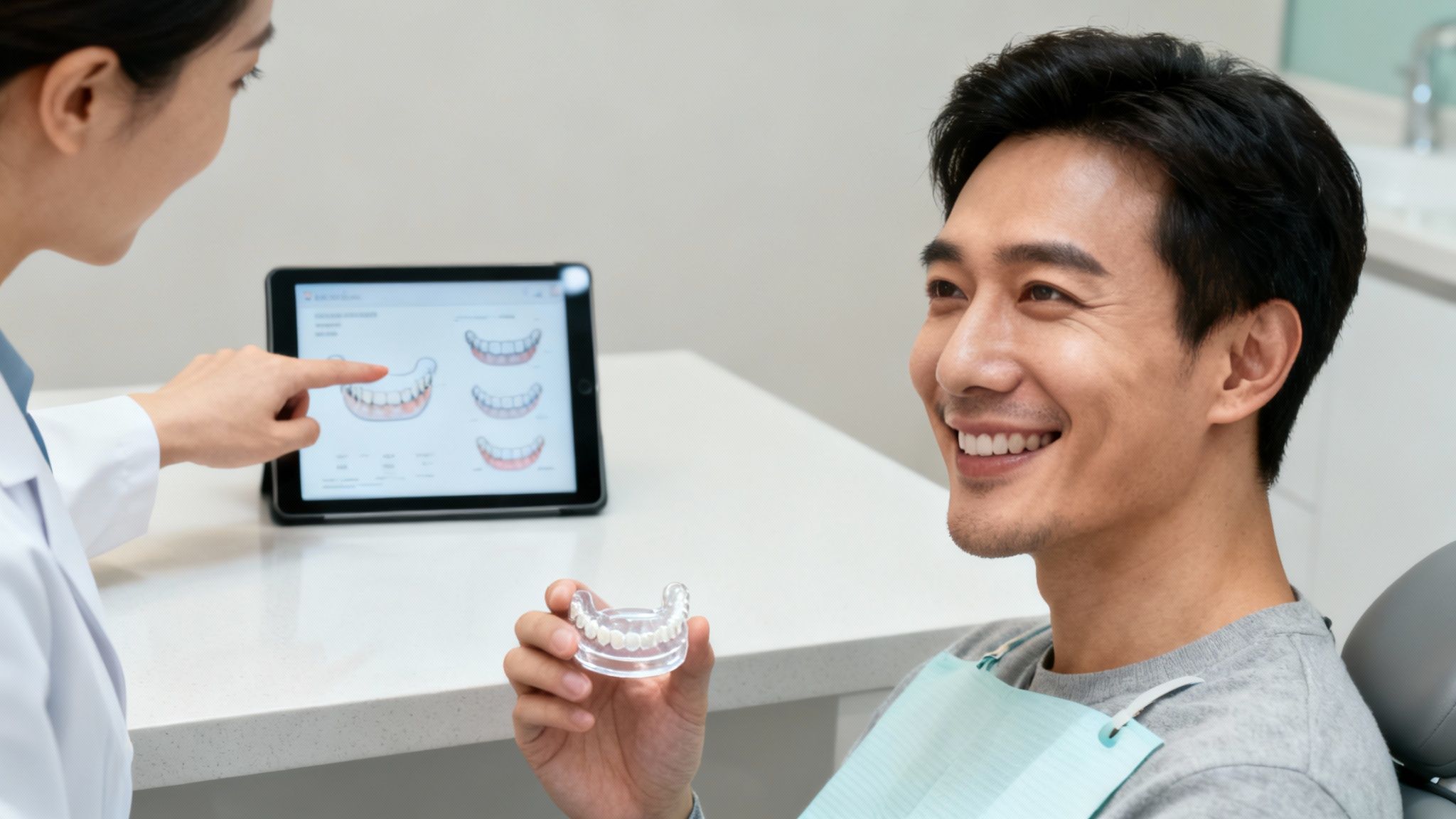
Making an informed decision means balancing several key factors. Before exploring specific treatments, consider what matters most to you. We'll compare each option using four practical criteria to help you find the perfect fit.
Here’s what you should evaluate:
The most effective orthodontic solution is one that integrates seamlessly into your life. The goal is to find a treatment that aligns your teeth without disrupting your routine, confidence, or budget.
This guide categorizes the most popular teeth straightening options for adults, outlining the purpose and ideal candidate for each. This balanced comparison will help you understand the real-world trade-offs of every path.
By keeping these fundamentals in mind, you can explore the detailed comparisons in the next sections with confidence, moving one step closer to the healthy, beautiful smile you deserve.
When adults consider straightening their teeth, the choice often comes down to two primary options: clear aligners and traditional braces. Both are highly effective, but they offer very different experiences. The decision isn't about which is "better," but which is better for your specific needs and lifestyle.
Let's break down the practical differences in aesthetics, daily routine, and overall lifestyle impact to provide a clear picture of what to expect.
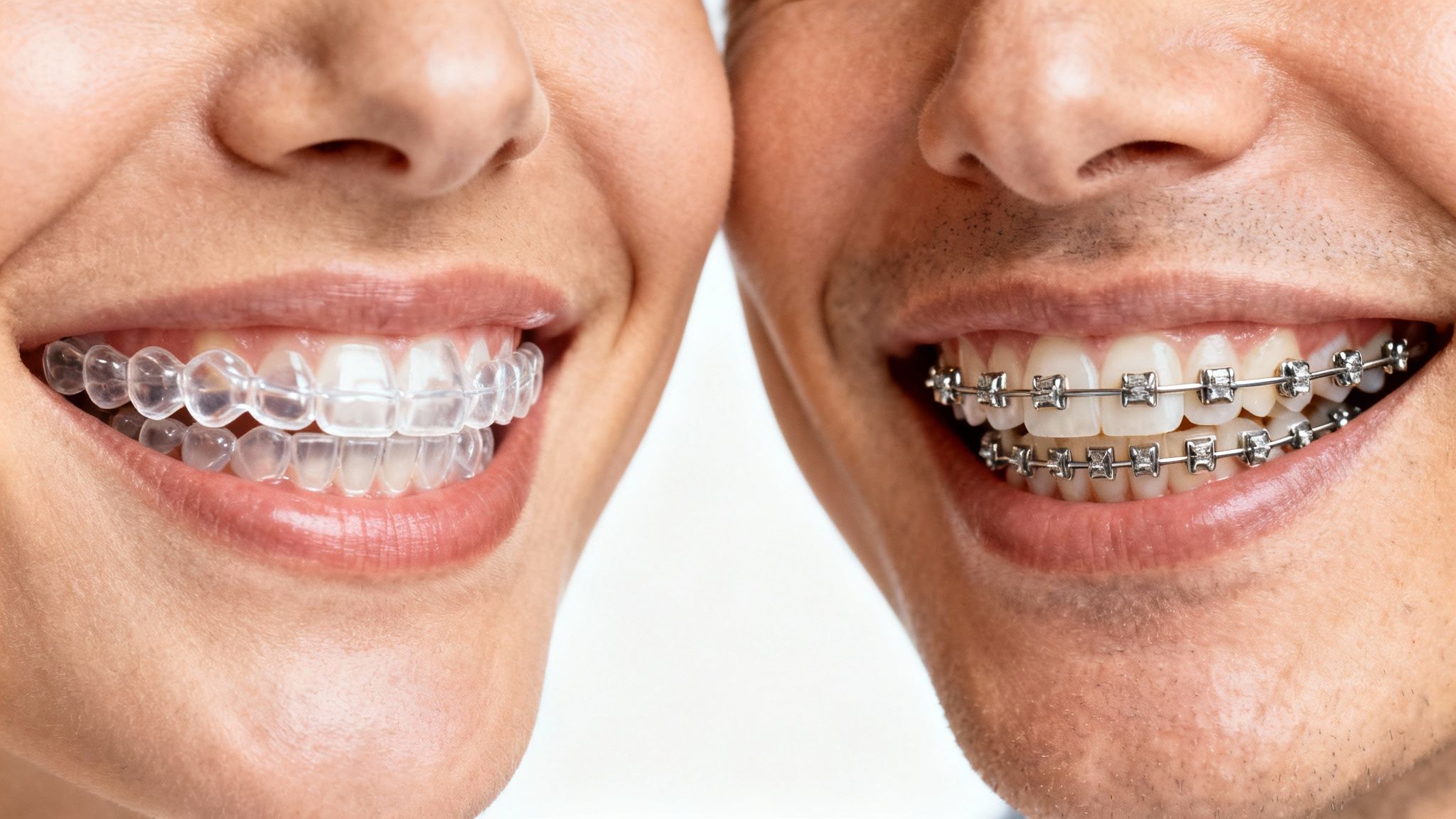
For most adults in a professional environment, visible metal braces can be a significant concern. Clear aligners were designed to solve this problem. Made from transparent, medical-grade plastic, they fit snugly over your teeth and are practically invisible. You can smile, speak, and lead meetings without feeling self-conscious.
Traditional metal braces are undeniably noticeable. Although modern designs are smaller and more streamlined, they remain visible. This is a functional trade-off: their constant, powerful straightening force in exchange for visibility.
The core difference is control. Clear aligners offer the flexibility of removal for important events, while braces provide the assurance of constant, non-removable correction.
Your daily habits will change based on your choice. The most significant difference is that clear aligners are removable, while braces are fixed for the duration of your treatment.
With clear aligners, you must remove them every time you eat or drink anything other than water. This gives you complete dietary freedom—no need to avoid popcorn or crunchy foods. However, it requires a strict routine: remove aligners, store them safely, eat, brush your teeth, and reinsert them promptly.
Traditional braces require a different kind of diligence. Because they are fixed, oral hygiene becomes more complex, requiring special techniques to brush and floss around brackets and wires. You'll also need to avoid certain foods—like hard candies, sticky caramel, and nuts—that can damage the appliance.
The rising popularity of aligners indicates a shift in patient priorities. The global clear aligners market, valued at USD 6.49 billion, is projected to hit USD 32.35 billion by 2030. This shows that people want effective treatment that accommodates their lifestyle. For more details on the process, read our guide on how clear aligners work.
While appearance and convenience are important, the final decision should be based on your clinical needs. Both options are excellent for straightening teeth but excel in different areas.
Traditional braces remain the top choice for complex orthodontic cases. For severe bite issues, significant tooth rotations, or major alignment problems, braces offer a level of control and precision that is difficult to match. The orthodontist can make fine-tuned adjustments to each tooth for predictable, powerful movements.
Clear aligners are highly effective for mild to moderate issues, including crowding, gaps, and minor bite misalignments. Technological advancements have expanded their capabilities, but their success is 100% dependent on patient compliance. You must wear them for the prescribed 20-22 hours per day to achieve the desired results.
Seeing them side-by-side clarifies the day-to-day differences.
This table breaks down the key distinctions to help you decide which option better suits your needs and lifestyle.
Ultimately, choosing between these two powerful options comes down to your priorities. Do you value the flexibility and near-invisibility of aligners, or do you need the raw corrective power of braces for a more complex situation? Your smile goals and daily life will guide you to the right answer.
While clear aligners are a popular discreet option, they aren't the only choice. For adults who require the mechanical strength of traditional braces but prefer a low-profile appearance, two excellent alternatives are ceramic braces and lingual braces.
Both deliver the same corrective force as metal braces but are designed with aesthetics in mind. Each offers a different approach to subtlety, so let's examine them to see which might be the best fit for your smile and lifestyle.
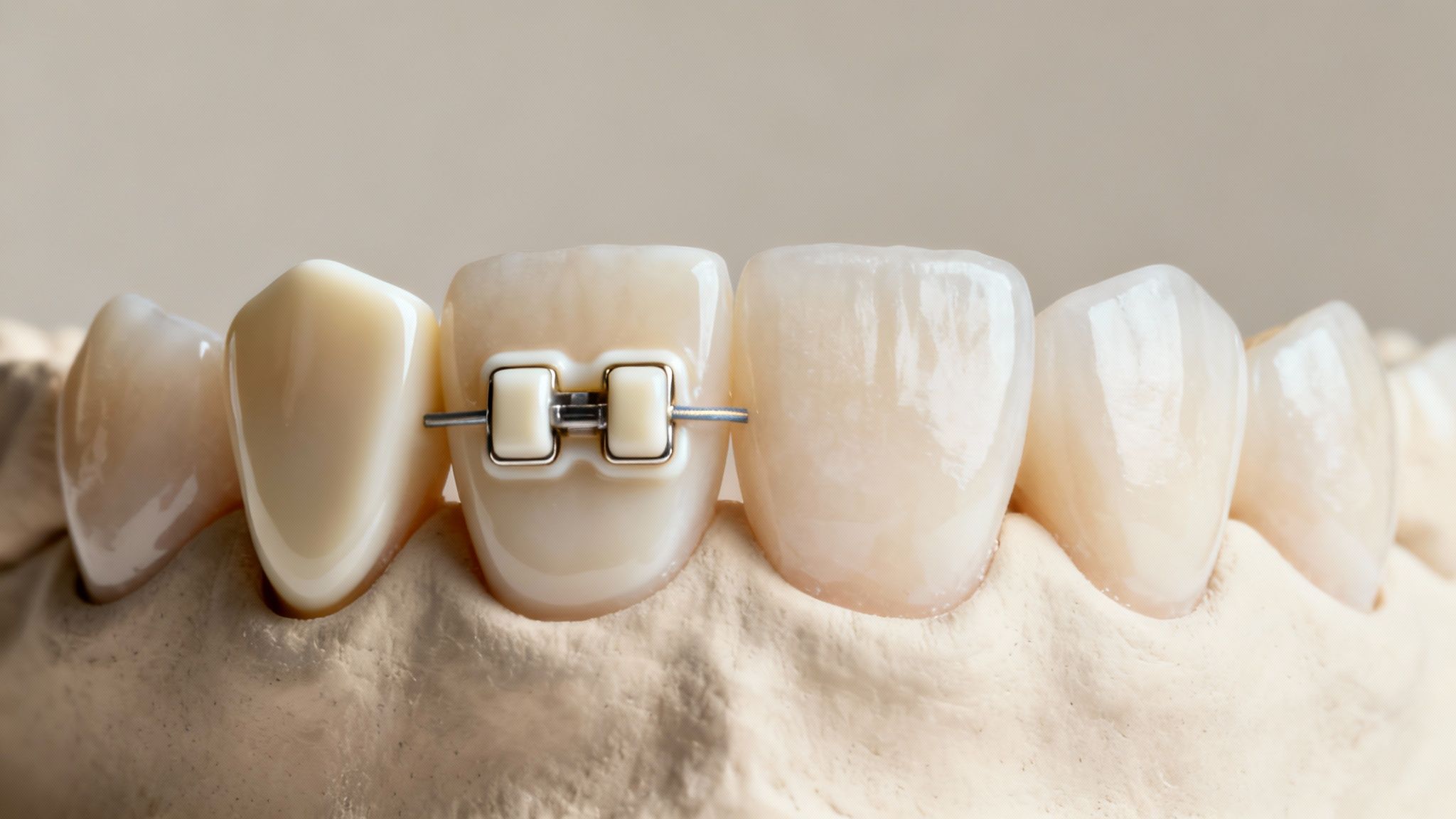
Ceramic braces function identically to traditional metal braces, using brackets and an archwire to guide teeth into position. The key difference is the material: the brackets are made from a translucent ceramic that blends with your natural tooth color.
This makes them a popular middle-ground solution. You get the robust, fixed force needed for complex movements without the prominent "metal mouth" look. From a normal conversational distance, they are significantly less noticeable than traditional braces.
However, there are a few practical considerations:
For complete invisibility, lingual braces are the definitive choice. They are the only 100% hidden orthodontic appliance because they are custom-made and bonded to the back (lingual side) of your teeth. No one will know you are undergoing orthodontic treatment unless you tell them.
This makes them an ideal option for professionals, performers, or anyone who feels self-conscious about visible orthodontics. Since they are fixed in place, they work 24/7 to correct even severe alignment issues without requiring you to remember to wear them.
Lingual braces offer a unique combination: maximum corrective power and complete invisibility. They are a prime example of advanced orthodontic technology working entirely behind the scenes.
This unique placement comes with its own set of trade-offs. The initial adjustment period can be more challenging for some individuals. With the brackets positioned against your tongue, you may experience a temporary lisp or some irritation as your mouth adapts. Oral hygiene also has a learning curve; cleaning brackets you cannot see takes practice and specialized tools.
So, which is right for you? The choice depends on your personal priorities. This table outlines scenarios where one might be a better choice over the other.
Both ceramic and lingual braces are excellent solutions for adults seeking a straighter smile without sacrificing aesthetics. The best choice depends on how you balance subtlety, comfort, daily maintenance, and your budget.
For many adults, the primary obstacle to orthodontic treatment isn't cost or appearance—it's time. The prospect of spending years in braces or aligners can feel like too great a commitment. This is where accelerated orthodontics comes in, using advanced techniques to significantly reduce treatment time without compromising the final results.
These methods don't replace primary treatments like clear aligners or braces but work with them to enhance the body's natural tooth-movement process. By gently stimulating the bone and tissue surrounding the teeth, we can encourage a faster, more efficient realignment. This approach is ideal for adults with busy schedules, upcoming life events, or anyone eager to see their new smile sooner.
Two of the most trusted methods for accelerating treatment involve gentle stimulation to help teeth move more easily. These are either non-invasive or minimally invasive procedures that integrate seamlessly into your existing orthodontic plan.
The principle behind accelerated orthodontics is to work with your body's natural healing abilities. By creating a more active environment for bone remodeling, we can guide your teeth into perfect alignment more quickly and efficiently.
Sometimes, crooked teeth are a symptom of a deeper issue rooted in the jaw's structure. For severe cases involving major bite problems, facial asymmetry, or other skeletal discrepancies, orthodontics alone may not be sufficient to achieve a stable, functional, and aesthetic result.
In these situations, orthognathic surgery (corrective jaw surgery) becomes an essential part of the treatment plan. This specialized procedure, performed by an oral and maxillofacial surgeon, repositions the upper jaw, lower jaw, or chin for proper alignment.
While this is one of the more intensive teeth straightening options for adults, the results can be life-changing. The surgery is almost always coordinated with orthodontic treatment—you will likely wear braces or aligners before and after the procedure to ensure your teeth are in the ideal position once your jaws are aligned.
Determining if you are a candidate for accelerated orthodontics or jaw surgery begins with a comprehensive evaluation. These advanced options are designed for specific situations:
The only way to know for sure is through a professional consultation. Our team at Clayton Dental Studio can assess your unique dental anatomy, discuss your goals, and determine if an advanced or accelerated path is the most effective way to achieve your ideal smile.
What if your ideal smile doesn't require moving your teeth at all? While orthodontic treatments physically shift teeth into a healthier alignment, sometimes the goal is purely aesthetic. For adults dealing with minor gaps, chips, stubborn stains, or slightly crooked teeth, cosmetic dentistry offers a much faster route to a flawless appearance.
These solutions don't change the underlying position of your teeth; instead, they mask visible imperfections. Think of it as renovating a building's facade rather than restructuring its foundation. This makes them one of the most efficient teeth straightening options for adults when the primary concerns are cosmetic.
Porcelain veneers are ultra-thin, custom-made ceramic shells permanently bonded to the front surfaces of your teeth. They are the gold standard for dramatic smile transformations, capable of correcting a range of cosmetic issues at once.
Veneers offer a permanently beautiful smile. They are highly resistant to stains from coffee, tea, and red wine, ensuring your smile stays bright for years. To better understand the investment, explore our detailed guide on how much veneers cost.
For a more conservative and affordable alternative, dental bonding is an excellent option that can often be completed in a single visit. A dentist applies a tooth-colored composite resin and skillfully sculpts it directly onto your tooth to correct imperfections.
This makes bonding a perfect solution for smaller-scale issues, such as repairing a chipped front tooth, closing a small gap, or improving the shape of a single tooth. The results are immediate, although the material is not as durable or stain-resistant as porcelain.
The key distinction is permanence versus flexibility. Veneers offer a complete and lasting smile overhaul, while bonding provides a quick, effective, and reversible solution for specific, minor flaws.
How do you choose the right path? The decision depends on the root cause of your concern and your ultimate smile goals.
Consider this common scenario: a patient has a small gap between their front teeth but is otherwise happy with their bite. Orthodontics could close the gap in 6-12 months. Alternatively, dental bonding could close the same gap in about an hour, or veneers could perfect the entire smile in just two appointments.
Here’s a quick comparison to guide your thinking:
If your concerns are purely cosmetic and your bite is healthy, veneers or bonding can deliver your dream smile in a fraction of the time. The best way to know for sure is to come in for a consultation at Clayton Dental Studio. We can walk you through all the options and help you determine which path is right for your unique smile.
With numerous ways to straighten adult teeth, determining where to begin can feel overwhelming. Having explored options from discreet aligners to major cosmetic fixes, let's consolidate the information to help you select the treatment that best fits your life, budget, and aesthetic goals.
Each option presents a unique set of trade-offs. Your final decision will likely balance key factors: treatment visibility, duration, and total financial investment. There is no single "best" choice—only the one that is right for you.
To simplify the decision-making process, start with a fundamental question: do you need to physically move your teeth to correct an alignment or bite issue, or are you looking to improve their appearance cosmetically?
This flowchart illustrates that initial choice.
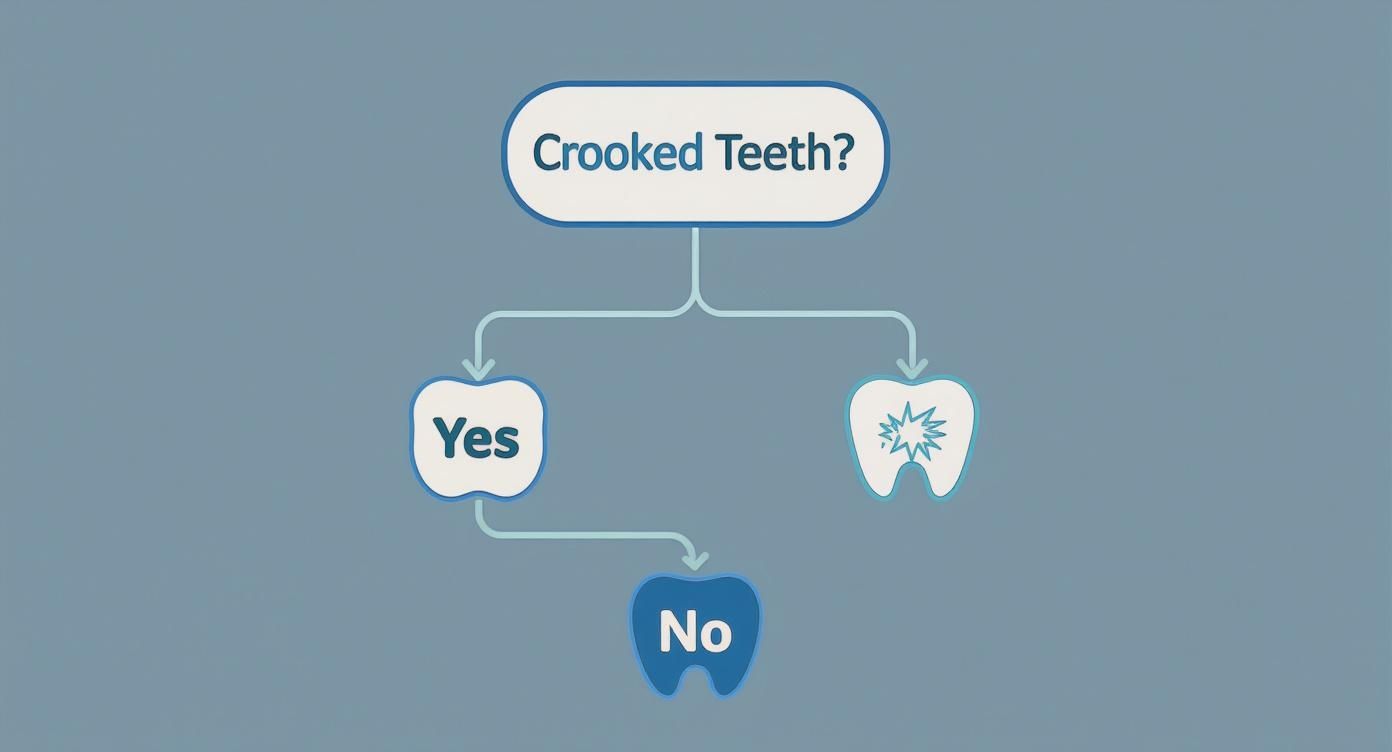
As the visual indicates, if your teeth are genuinely crooked or your bite is misaligned, orthodontic solutions are the correct path. If the issue is related to superficial flaws, cosmetic options are often a more efficient fit.
To help you compare the details side-by-side, this comprehensive table breaks down the most important factors for each treatment discussed.
This chart is a useful starting point, but remember these are general guidelines. Your actual treatment plan and costs will depend entirely on your specific dental needs. A thorough dental exam is the only way to get an accurate diagnosis and a customized treatment plan. Factors like your bite alignment, gum health, and the root cause of the issue are critical elements that only a dentist can properly assess.
Your smile is unique, and your treatment plan should be, too. A professional consultation moves beyond general information to create a specific, actionable strategy tailored to your dental anatomy and personal goals.
This is where our team at Clayton Dental Studio can help. During a consultation, we will discuss all viable teeth straightening options for adults, answer your questions, and map out a clear path forward. Whether you are a perfect candidate for clear aligners or could achieve your dream smile faster with veneers, we provide honest, patient-focused guidance.
If a discreet and flexible treatment sounds like the right fit, you can learn more about our popular clear aligners in Humble.
Ready to take the next step? Schedule your consultation today and let's start building your new smile together.
Deciding to straighten your teeth as an adult is a significant step, and it's natural to have questions. You're balancing a career, social life, and budget, so you want to be certain you're making the right decision.
We've compiled answers to the most common questions we hear from adults to provide clear, straightforward information and help you feel confident in your choice.
Absolutely not. This is a common misconception, but there is no age limit for achieving a smile you love. We have successfully treated patients in their 30s, 50s, and even 70s.
The critical factor is not your age but the health of your teeth and gums. As long as your jawbone and gums are healthy enough to support the gentle movement of your teeth, you are a candidate for orthodontic treatment. A simple evaluation at our studio can confirm this.
The experience is much more manageable than most people imagine. You can expect mild pressure or soreness for a day or two after your braces are first applied or when you switch to a new set of clear aligners. This is a sign that the treatment is working.
This temporary discomfort is easily managed with over-the-counter pain relievers and typically fades quickly. Modern orthodontic techniques use slow, consistent force, making the process far more comfortable than it was in the past.
This is a valid concern for many adult patients and a key reason why discreet options have become so popular. Today's treatments are designed for minimal impact on your daily interactions.
Most patients adapt quickly and find that their treatment has little to no effect on their professional life.
The beauty of modern adult orthodontics is how well it integrates into your life. You don't have to put your professional image on hold to achieve a healthier smile—you can have both.
The cost of straightening your smile varies depending on the complexity of your case and the chosen treatment. Generally, the cost falls between $3,000 and $8,000. More specialized treatments, like lingual braces or surgical orthodontics, are at the higher end of this range.
Many dental insurance plans now offer at least partial coverage for adult orthodontics, which can significantly reduce your out-of-pocket expenses. We believe finances should not be a barrier to achieving a healthy smile, which is why we offer flexible financing options to create a payment plan that works for you.
Ready to discover the right path to a straighter smile? At Clayton Dental Studio, Dr. Navneet Kamboj and our team provide personalized advice and answer all your questions. We are proud to serve our neighbors in Humble, Atascocita, and the greater Houston area with modern, compassionate dental care.
Schedule your consultation today and see how close your dream smile really is.