

Book Your Appointment Today!
Our staff will reach out to you shortly
Thank you! Your submission has been received!
Oops! Something went wrong while submitting the form.


You’re in the dental chair, a sensor is gently positioned, and someone asks you to “hold still for just a second.” From the patient side, a dental X-ray can look simple. From the clinical side, getting a clean, useful image takes skill, good positioning, and careful attention to safety.
One of the most common technical issues in intraoral imaging is cone cutting. The name sounds odd, and sometimes a little alarming, but it isn’t a dangerous event or a sign that something has gone wrong with your mouth. It’s a positioning issue on the image itself. In plain terms, part of the X-ray beam misses the sensor, so part of the picture comes out blank.
That matters because a blank area can hide the exact detail your dentist needs to see. If the missing area covers the root tip of a tooth, the space between teeth, or part of the bone level, the image may not answer the clinical question. If the blank area sits off to the side and the important anatomy is still visible, the X-ray may still be perfectly usable.
Patients often wonder whether a retake means something was unsafe or careless. New dental assistants often worry that one cone cut means they’ve failed. Neither is true. Cone cuts are a known challenge in dental radiography, especially when teams use beam-restricting methods that lower radiation exposure.
That’s why modern offices combine training, digital imaging, and quality checks to reduce errors and keep the process efficient. If you’ve ever had questions about digital dental X-rays in Humble, understanding cone cutting can make the whole experience feel much less mysterious.
A good dental X-ray experience feels quick, calm, and uneventful. You bite gently, stay still, and a few moments later the image appears on a screen. What often goes unnoticed is the small choreography behind that moment. The sensor has to sit in the right place, the holder has to stabilize it, and the X-ray tube has to be aimed precisely.
For a new assistant, this is one of the first lessons that separates “taking an image” from capturing a diagnostic image. The difference is subtle but important. A diagnostic image shows the anatomy the dentist needs to evaluate, without a blank area cutting across the region of interest.
For a patient, it helps to think of this like taking a photo in dim light. If the camera points slightly off target, the subject may be partly missing even if the rest of the photo looks fine. In dental radiography, that partial miss is often what people mean by cone cutting.
Patients usually notice cone cutting only indirectly. They may hear, “We need one more image,” or they may see the team adjusting the holder more carefully on the second try. That can raise understandable questions about radiation, comfort, and whether something is wrong.
A retake isn’t about perfection for its own sake. It’s about making sure the image shows enough anatomy to support a safe diagnosis.
New team members often focus first on speed. That’s normal. But in radiography, speed without alignment creates repeat work. Learning to center the beam, seat the receptor correctly, and check the aiming ring before exposure saves time later and reduces avoidable retakes.
A strong routine usually includes these habits:
Cone cutting often comes up in conversations about modern radiography because the same tools that help reduce exposure can demand more precision. That’s a good trade when the team is trained and the system gives fast feedback.
Patients want two things at once. They want the lowest reasonable radiation exposure and they want to avoid unnecessary repeat images. Good radiographic technique aims for both.
Cone cutting is a positioning error. It happens when the X-ray beam doesn’t fully cover the image receptor, which creates a clear or white area on the radiograph and blocks part of the anatomy. This usually happens because the position-indicating device, or PID, is not centered correctly over the receptor, as explained in the IHS radiographic technique guidance.

Think of the X-ray beam like a flashlight. If you shine the flashlight directly over a note card on the wall, the whole card lights up. If you aim slightly too high or too far to one side, part of the card stays dark. Cone cutting is the radiographic version of that miss.
The receptor, whether it’s film, a PSP plate, or a digital sensor, is the “note card.” The beam has to fully cover it. If it doesn’t, the uncovered part won’t record the image.
This is one reason teams using advanced systems still rely on careful setup and modern dental technology. Technology helps, but aiming still matters.
Cone cuts are often easy to spot once you know what you’re looking for. The blank area usually appears at the edge of the X-ray.
The shape depends on the shape of the PID:
That visual clue helps clinicians identify the cause quickly. It tells them this wasn’t decay, infection, or an anatomical finding. It was a beam alignment issue.
Practical rule: If the image has a clean blank border with a curved or straight edge, think positioning first.
A lot of people hear “cone cut” and assume the machine physically touched or damaged something. It didn’t. The term refers to the image result, not an injury. Nothing is being cut in the mouth.
Another common confusion is the word “cone.” Modern PIDs may be round or rectangular. The old term stuck, even though the visible mark can be square rather than cone-shaped.
The same IHS guidance notes that rectangular collimation reduces patient radiation dose by over 40% while also requiring more precise aiming because the beam is tighter and less forgiving on the image edges. That’s the tradeoff. You use a more restricted beam to lower exposure, but you have to center it carefully.
For both staff and patients, that’s an important point. A cone cutting dental x ray issue doesn’t mean the safer approach was a mistake. It means safer beam restriction comes with less room for alignment error.
The most common reason for cone cutting is simple. The beam and the receptor aren’t lined up. That mismatch became more noticeable as dentistry adopted rectangular collimation to reduce exposure, and technique errors, including cone cuts, account for up to 20 to 30% of all retakes in dental radiography according to Overjet’s review of dental imaging problems.
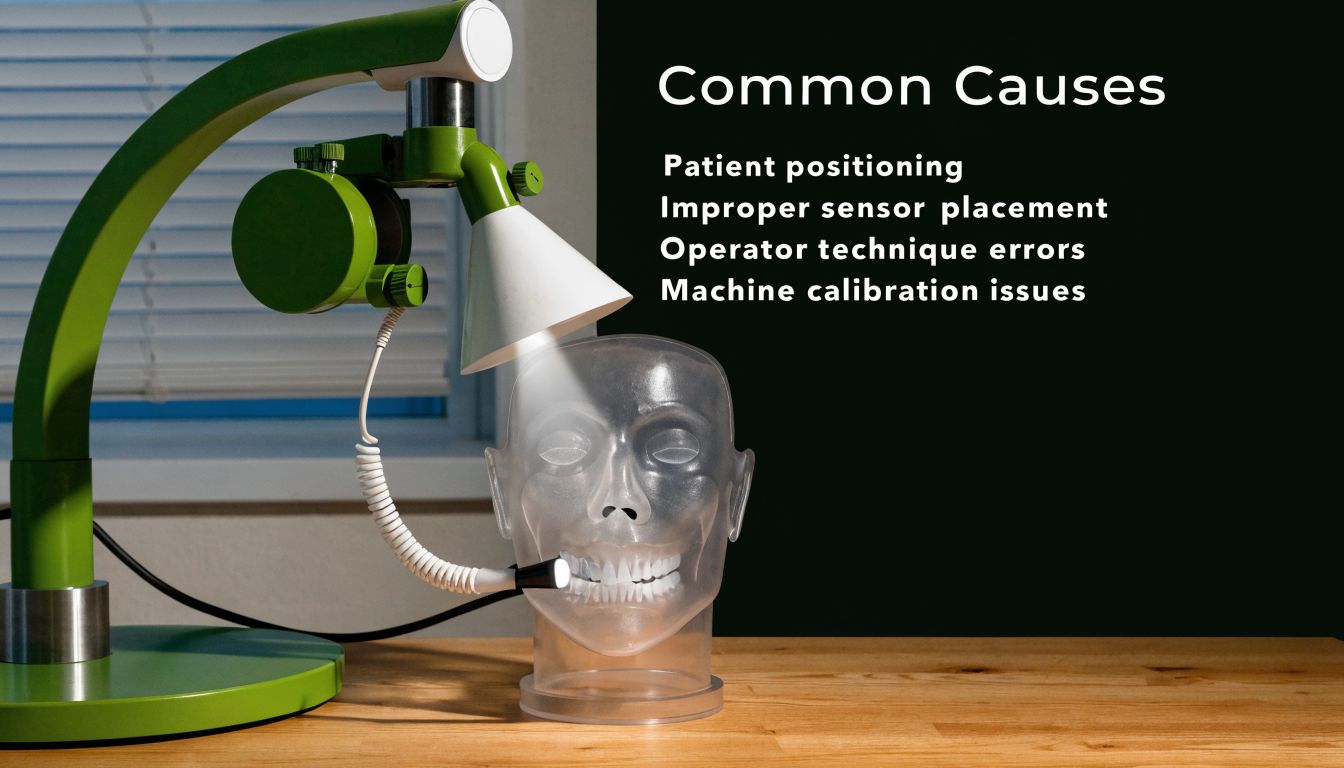
Posterior images are especially prone to this problem. That makes sense in daily practice. Molars are farther back, space is tighter, patients may have a strong gag reflex, and the holder can be harder to seat and stabilize.
Some cone cuts happen because of a tiny aiming miss. Others start with receptor placement and only show up on the final image.
Here are the patterns clinicians watch for:
A lot of training starts with the tube head, but the receptor often sets up the problem first. If the sensor is rotated or not fully positioned behind the area of interest, even a carefully aimed beam can produce a cut edge.
This is why experienced assistants pause before exposure. They check the holder, the receptor depth, and the angle of the PID as a single system instead of treating them as separate tasks.
The short demonstration below gives a useful visual sense of positioning and alignment in practice.
A compact reference can help when you’re learning or troubleshooting mid-appointment.
Cause of Cone CutCorrective ActionPID off-center over receptorRe-center the PID over the aiming ring before exposureReceptor too shallow or too deepRe-seat the sensor so the needed anatomy sits within the capture areaReceptor not parallelReposition the holder to improve parallelism and stabilityPatient closes unevenly or movesGive simple instructions, pause, and reposition before retakingHolder assembly shiftedRebuild or tighten the holder and verify alignment visuallyPosterior access is limitedSlow down, adjust insertion path, and confirm beam coverage before exposing
When a cone cut appears, don’t jump straight to “the machine missed.” Ask three fast questions:
That sequence helps new assistants find the true cause instead of making the same correction twice.
Not every cone cut ruins an image. That’s the key clinical point. The important question isn’t, “Is this picture perfect?” It’s, “Can we still see the anatomy needed to make a sound decision?”
In a large study of 53,684 intraoral radiographs, cone cut errors occurred in 21% of images taken with rectangular collimation, but only 3% of all images were completely unusable, while 18% of those with cone cuts still retained full diagnostic value, supporting rectangular collimation because it can reduce radiation exposure by up to 60% under the ALARA principle, according to the 2023 PubMed-indexed study.

A cone cut can be present and the image can still be useful if the blank area doesn’t cover the structures the dentist needs to assess. For example, if the root tips, surrounding bone, and contact areas are visible, a limited cut at the edge may not change diagnosis or treatment.
That’s why clinicians don’t judge the image by the artifact alone. They judge it by what is still visible.
A retake usually makes sense when the cone cut hides a critical landmark. Common examples include:
If the missing area hides the reason the image was taken, retaking it protects the patient more than accepting an incomplete view.
The large study is helpful because it shows two things at once. Cone cuts are common enough that every dental team needs to manage them well. But a completely unusable image is uncommon compared with the total number of radiographs taken.
That means patients shouldn’t assume a cone cut automatically leads to more exposure. The clinical decision is selective. Teams retake only when the anatomy needed for diagnosis isn’t visible.
For assistants, this is a judgment skill as much as a positioning skill. The goal isn’t cosmetic perfection on the screen. The goal is a clear answer to the diagnostic question.
Preventing cone cutting starts before the exposure button is pressed. A careful setup reduces stress for the patient and gives the operator a much better chance of getting the image right the first time.
Research summarized in a 2023 open-access review notes that rectangular collimation reduces patient radiation by at least 40%, but the tighter beam raises the risk of cone cuts if alignment is off. That same review describes how AI-powered digital X-ray systems can instantly flag positioning errors and how emerging automated positioners with laser guides have shown potential in pilot studies to reduce errors by over 50%.

Good radiography is built on repeatable habits, not luck. In day-to-day practice, teams focus on a few essentials.
Chairside reminder: Slow is smooth, and smooth prevents retakes.
Even strong teams see occasional cone cuts. The key is to correct them methodically.
A practical sequence looks like this:
Digital imaging changes the workflow because the team sees the result right away. That immediate feedback turns every image into a quick quality check. If a cone cut appears, the operator can evaluate it on the spot rather than discovering the problem later.
AI adds another layer by helping flag positioning issues rapidly. It doesn’t replace training, but it supports it. In busy schedules, especially when same-day treatment decisions depend on radiographs, that extra check can help teams stay consistent while keeping the focus on patient safety.
From the patient side, cone cutting dental x ray concerns usually boil down to three questions. Will this be safe? Will it be comfortable? Will I need to do it again?
The best answer is clear communication paired with visible precision. Patients feel more at ease when the team explains what the holder does, why they’re adjusting the tube head carefully, and what will happen if an image needs a second look.
A well-run X-ray appointment should feel guided, not rushed. You’ll usually hear short, specific instructions such as where to bite, how to hold still, and when the exposure is happening. That matters because clear coaching improves comfort and helps reduce movement-related errors.
For children, gag-prone patients, and anyone nervous about costs or extra time, the conversation matters just as much as the equipment. The team should explain the reason for any repeat image in plain language, without making the patient feel responsible.
The Dentalcare guidance on technique errors emphasizes that patient communication is key, and that explaining tools such as laser-guided positioning systems with language like, “We use this laser to get the image right the first time, minimizing your radiation exposure,” helps build trust.
Patients don’t need to understand every technical detail to appreciate careful imaging. They can see when a team uses alignment devices thoughtfully. They can hear when instructions are calm and specific. They can tell when the staff reviews images immediately rather than leaving uncertainty hanging.
That matters in family dentistry, where one room may have a curious adult patient and the next may have a child who is already worried about biting on a sensor. A patient-first approach turns a technical process into a more manageable experience.
Trust grows when the team says what they’re doing and does what they said. If an image is good, they move on efficiently. If a retake is needed, they explain why and what they changed.
Patients looking into a new patient special often ask about comfort, efficiency, and whether modern imaging really makes a difference. In everyday practice, it does. Better alignment, better feedback, and better communication make the appointment smoother for everyone involved.
A few signs of a patient-centered radiography visit include:
Patients rarely remember the technical term. They remember whether the team made the process feel careful, quick, and respectful.
If you want a dental team that combines modern imaging, clear communication, and a patient-first approach, schedule a visit with Clayton Dental Studio. Whether you’re bringing in a child for routine care, need answers about a sore tooth, or just want a more comfortable X-ray experience, the team is here to help.