

Book Your Appointment Today!
Our staff will reach out to you shortly
Thank you! Your submission has been received!
Oops! Something went wrong while submitting the form.


The best way to fix a chipped tooth depends directly on the severity of the damage and its location in your mouth. For minor cosmetic chips on front teeth, dental bonding offers a fast, one-visit solution. For a larger fracture, particularly on a back molar that endures significant chewing force, a dental crown provides the necessary strength and long-term protection.
The moment a tooth chips can be alarming. Your immediate actions are critical for managing pain, preventing further damage, and improving the chances of a successful repair. Follow these practical first-aid steps before you can get to a dentist.
As soon as you notice the chip, assess the situation calmly. Taking these immediate protective steps can significantly influence your treatment's outcome.
"A common mistake is waiting to see if the pain subsides. Any chip, no matter how small, compromises the tooth's structure and should be evaluated promptly by a professional to rule out deeper, unseen cracks."
Delaying a dental visit can escalate a minor chip into a major problem requiring more extensive treatment. The primary goal is always to preserve your natural tooth. Research supports this, showing that timely endodontic treatment for teeth at risk of cracking has an overall survival rate of 84.1% after 60 months. You can read more about the success rates of preserving cracked teeth on National Elf Service. This data underscores the importance of seeking prompt evaluation for any chip.
When you chip a tooth, selecting the best repair method is not a one-size-fits-all decision. The optimal solution depends on the chip's size, its location in your mouth, your budget, and your aesthetic goals. Understanding your options is the first step toward restoring your smile and confidence.
This guide provides an actionable framework for your next steps and clarifies the available treatments.
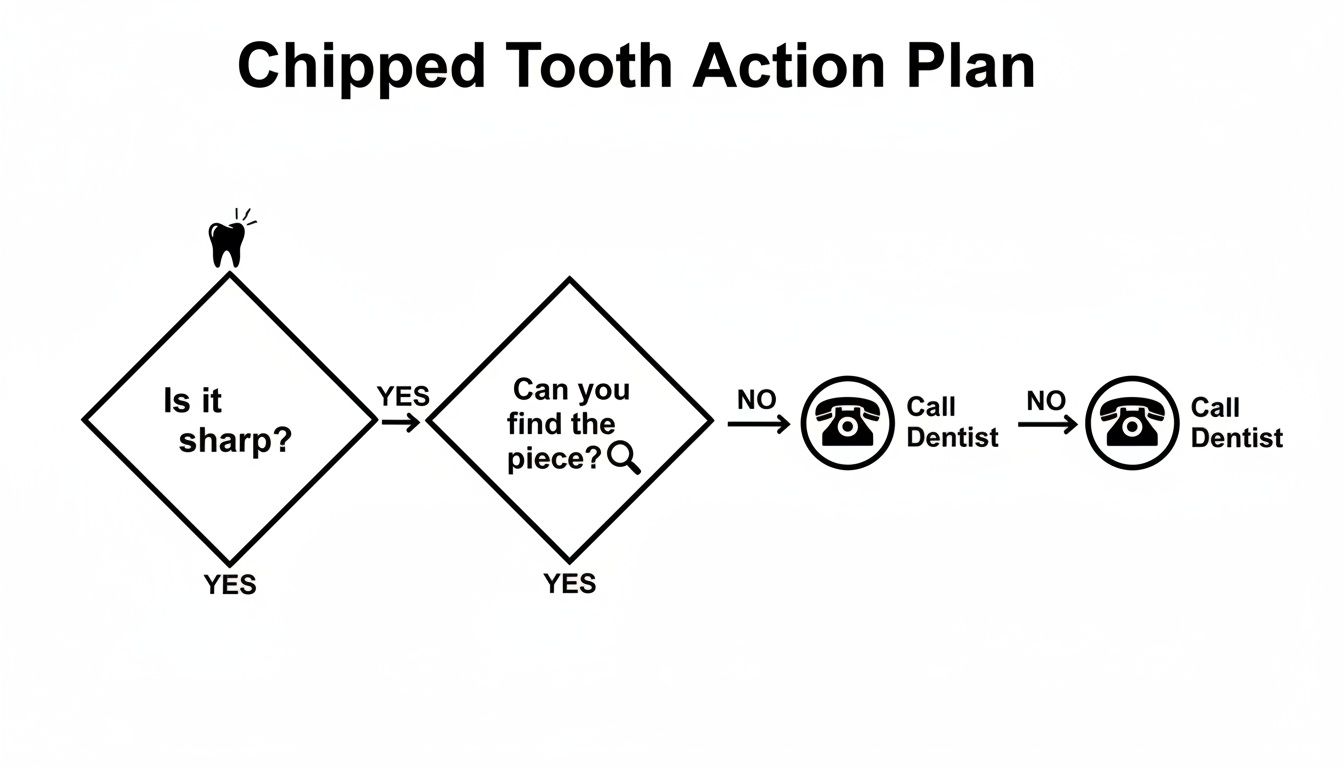
As the flowchart illustrates, regardless of the chip's characteristics—whether it feels sharp, you have the fragment, or you don't—the most crucial action is to call your dentist. A professional evaluation is the only way to diagnose the full extent of the damage and recommend a durable, effective repair.
To simplify your decision-making, this comparison table highlights the key differences between common treatments.
Each of these treatments serves a specific purpose. Let's explore practical scenarios to determine which solution is right for you.
Imagine you accidentally bite down on a fork, creating a small, rough edge on a front tooth. It doesn't hurt, but it's a constant annoyance and makes you self-conscious. This situation is the ideal candidate for dental bonding.
Bonding is a cosmetic procedure where a dentist skillfully sculpts a tooth-colored composite resin directly onto the damaged area. It's a quick, minimally invasive process completed in a single visit, often without needing anesthesia. For small, visible chips, it is the most efficient and cost-effective option.
For a minor chip on a highly visible tooth where speed and budget are priorities, dental bonding offers an immediate and aesthetically pleasing repair. It perfectly restores the tooth’s shape in one appointment.
The primary consideration with bonding is that the material can stain over time, similar to natural teeth, and it lacks the durability of porcelain. While it lasts for several years, it may require future touch-ups or replacement.
Now, consider a larger chip on a front tooth, or a tooth that also has discoloration or other minor imperfections. If you desire a more durable and transformative solution, a porcelain veneer is the superior choice.
A veneer is an ultra-thin, custom-fabricated shell of high-strength ceramic that is bonded to the entire front surface of the tooth. While bonding acts as a patch, a veneer provides a completely new, flawless facade.
Veneers represent a greater financial investment than bonding but deliver a superior, long-lasting cosmetic result. They are the best way to fix a chipped tooth when you also want to enhance your overall smile.
What if you break off a large piece of a back tooth while chewing something hard? In this case, the priority shifts from aesthetics to structural integrity. A large fracture on a molar, which withstands immense chewing forces, requires a solution designed for strength and protection: a dental crown.
A dental crown, or "cap," encases the entire visible portion of the tooth down to the gumline. It acts like a protective helmet, holding the compromised tooth together, absorbing bite pressure, and preventing further cracking.
At Clayton Dental Studio, we utilize same-day CEREC crowns to restore your tooth in a single appointment. Using advanced digital imaging, we can design, fabricate, and place your permanent, perfectly matched ceramic crown in one visit, eliminating the need for temporary crowns and multiple office trips. It's the most effective way to restore function and prevent the complete failure of a badly chipped molar.

When a chip becomes a major fracture, cosmetic fixes like bonding are insufficient. A tooth that has lost a significant portion of its structure, especially a molar responsible for heavy chewing, needs a solution engineered for durability. This is the role of a dental crown.
A crown is a custom-fit helmet for your tooth. It doesn't just patch the damage; it covers and protects the entire visible tooth structure. This full-coverage approach is what makes it superior to bonding or veneers for severely compromised teeth. It effectively absorbs and redirects biting forces, preventing the weakened tooth from fracturing further, which could lead to tooth loss.
A crown is a structural restoration, not a minor cosmetic enhancement. Understanding when a crown is necessary can prevent future complications and repeated dental visits.
A crown is typically recommended in these specific situations:
For a severely damaged tooth, a dental crown is not just a repair—it's a long-term investment in your dental health. It's the most reliable way to restore function and prevent a catastrophic failure of the remaining tooth structure.
The clinical evidence for this is compelling. A 2021 study on teeth post-root canal found that survival rates were significantly lower without a crown. For patients who received one, the survival rate increased to an impressive 97%. You can see the research findings on crown success rates after root canals on PubMed for yourself.
Traditionally, getting a crown was a multi-week process involving at least two appointments and a temporary restoration. Today, technology has changed the game. At Clayton Dental Studio, we use CEREC (Chairside Economical Restoration of Esthetic Ceramics) technology to complete the entire procedure in a single visit.
With CEREC, we can digitally design, mill, and place your permanent, high-quality ceramic crown in one appointment. You can walk in with a fractured tooth and leave a few hours later with a perfectly restored, natural-looking smile—no messy impressions, no temporary crowns, and no waiting.
You can learn more about the specific dental crown procedure in our detailed guide. This advanced technology makes receiving a strong, beautiful restoration more convenient than ever.
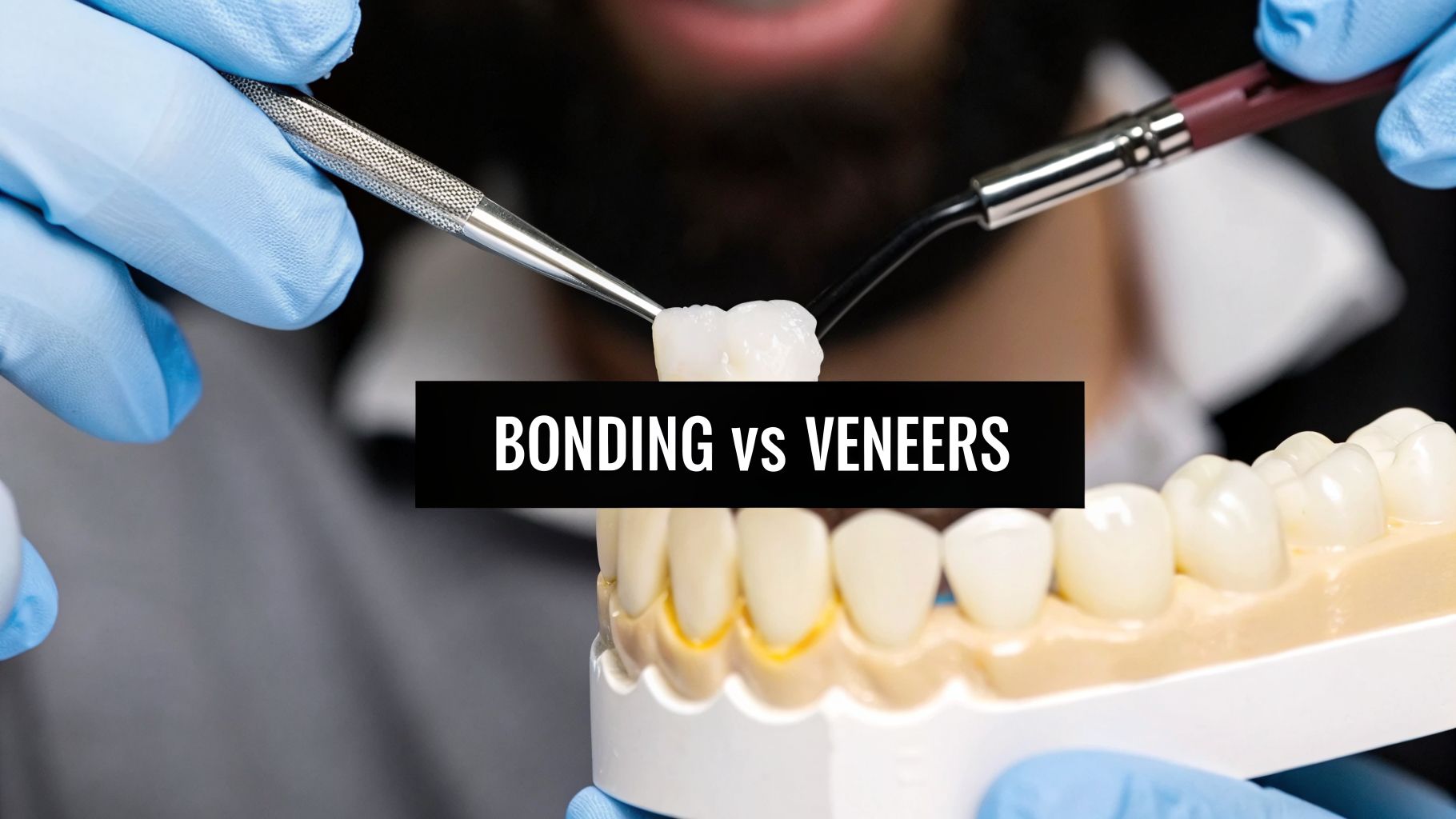
When a chip is small and on a front tooth, the focus shifts from structural repair to smile perfection. While the damage may not pose a health risk, it can significantly impact your confidence. This is where two excellent cosmetic treatments come into play: dental bonding and porcelain veneers.
The choice between them involves balancing speed and cost against durability and aesthetics. Both are effective options, but they are designed to meet different long-term objectives. Understanding these key differences is crucial for selecting the right fix for your chipped tooth.
Think of dental bonding as a precise, artistic touch-up for your smile. In this procedure, the dentist applies a tooth-colored composite resin directly to the chipped area. This material is meticulously sculpted by hand to restore the tooth's natural contour, then hardened with a special curing light.
The primary advantages of bonding are speed and simplicity. The procedure is typically completed in a single, painless visit—often in under an hour—and usually does not require anesthesia. It is the most direct and budget-friendly method for repairing a minor cosmetic chip. You can learn more about the specifics of cosmetic dental bonding in our related article to determine if it is the right quick fix for you.
However, bonding does have limitations. The composite resin is porous and can stain over time, and it is not as strong as porcelain. With proper care, bonding can last for several years but will likely require touch-ups or replacement in the future.
If your primary goal is a perfect, long-lasting result, a porcelain veneer is the superior option. Unlike bonding, which patches a small area, a veneer is a custom-made, ultra-thin shell of high-grade ceramic that covers the entire front surface of the tooth. This not only conceals the chip but can also correct discoloration, minor gaps, and other imperfections simultaneously.
Veneers offer two significant advantages over bonding:
For anyone looking for a truly seamless and durable smile makeover, a porcelain veneer is the gold standard. It addresses the entire visible surface of the tooth, not just the chip, for a uniformly beautiful and lasting outcome.
The veneer process involves two appointments. During the first visit, we prepare the tooth and take precise digital scans. At the second appointment, we permanently bond your custom-fabricated veneer, ensuring a perfect fit and a seamless blend with your smile. While it represents a larger initial investment, its exceptional longevity and aesthetic superiority make it the best way to fix a chipped tooth for those seeking a picture-perfect smile.
While most chipped or cracked teeth can be saved, some fractures are too severe. If a crack extends deep below the gumline, attempting a repair is not a viable long-term solution. In these situations, the best course of action is often to extract the remaining tooth structure and replace it with a dental implant.
A dental implant is widely regarded as the premier solution for replacing a missing tooth. It consists of a small, biocompatible titanium post that is surgically placed into the jawbone, where it functions as a new, artificial tooth root. After it integrates with the bone, it provides a stable and durable foundation for a custom-made crown.
This solution does more than just fill a gap; it rebuilds the entire tooth from the root up, resulting in a replacement that looks, feels, and functions just like a natural tooth.
Losing a tooth triggers a hidden problem: the jawbone in that area begins to atrophy due to lack of stimulation. A dental implant is the only tooth replacement option that halts this bone loss. By mimicking a natural root, the implant stimulates the jawbone, preserving its strength, density, and your natural facial contours.
Here’s what sets them apart:
A dental implant is the closest you can get to turning back the clock and getting your natural tooth back. It’s the superior fix for an unsalvageable tooth because it restores everything—from the root to the chewing surface—for unmatched long-term health and stability.
However, don't give up hope too soon. Modern dentistry can often save even severely cracked teeth. A 2019 study showed that with proper root canal treatment and a protective crown, cracked teeth had a 100% survival rate after two years and 96.6% after four years. You can explore the full study's findings on saving cracked teeth on PubMed.
The dental implant process is a multi-stage journey toward a permanent solution. It begins with the careful extraction of the non-restorable tooth. Next, the titanium implant post is placed into the jawbone.
A healing period follows, during which the implant integrates with the bone (osseointegration). Once this fusion is complete, a connector piece (the abutment) is attached, which then supports a beautiful, custom-matched crown.
While the process takes more time than other fixes, the result is a durable, natural-looking tooth that can last a lifetime with proper care. You can learn more about dental implant longevity in our detailed article to understand why it is such a valuable investment in your oral health.
It's natural to have questions when considering dental treatment. When it comes to your smile, you need clear, actionable answers to make a confident decision. We understand.
Here are our direct answers to the most common questions we hear from patients in our studio, designed to give you clarity and peace of mind.
This is often the first question asked, and the answer depends entirely on the required treatment. The cost is directly tied to the complexity of the solution. Repairing a small cosmetic chip on a front tooth is a different and less costly procedure than restoring a major molar fracture.
Here's a practical breakdown of the investment levels:
The most important financial consideration is that delaying treatment almost always leads to higher costs. A simple bonding procedure today can prevent the need for a more expensive crown or root canal later if the damage worsens.
At Clayton Dental Studio, we are committed to transparent pricing. We also offer flexible financing options and an in-house savings plan to ensure that the best dental care is also affordable.
No, repairing a chipped tooth is a comfortable process with modern dental techniques. Your comfort is our top priority.
For a straightforward procedure like dental bonding, anesthesia is often not even necessary due to the non-invasive nature of the treatment.
For more involved procedures, such as preparing a tooth for a veneer or crown, we ensure the area is completely numb with local anesthetic before we begin. You will not feel any pain during the procedure itself. We are dedicated to providing a stress-free and comfortable experience.
We understand that a chipped tooth is an urgent concern, so we prioritize these cases. We reserve time in our schedule for same-day appointments to evaluate and treat your tooth as quickly as possible.
The total repair time depends on the specific treatment:
Prevention is the most effective strategy. Protecting your teeth from future chips involves a few key habits and proactive measures.
First, be mindful of what you chew. Avoid biting down on extremely hard objects like ice, pen caps, or hard candy. If you grind your teeth at night (a condition called bruxism), a custom-fitted nightguard is the single most effective way to protect your enamel from the intense forces that cause chips and fractures. Finally, if you or your children participate in sports, wearing a protective mouthguard is essential.
Ready to get your smile back to its best? The team at Clayton Dental Studio is here to provide the expert, compassionate care you deserve. Book your appointment online today!